SOLAR SECTOR BOUNDARY CROSSING: High-latitude auroras are possible on Oct. 14th when Earth crosses through a fold in the heliospheric current sheet. This is called a "solar sector boundary crossing," and NOAA forecasters estimate a 25% chance of polar geomagnetic storms when it occurs. Aurora alerts: text, voice
THE MYSTERIOUS BOULDERS OF COMET 67P: When the European Space Agency's Rosetta probe arrived at Comet 67P/Churyumov–Gerasimenko in August, one of the biggest surprises was the boulders: The comet's core is littered with them. Rosetta's OSIRIS camera photographed this specimen, a 45-meter-wide behemoth named "Cheops," on Sept. 19th:

On Nov. 12th, Rosetta will drop a lander onto the surface of the comet, and these boulders are a key hazard Philae must avoid.
But are they really boulders? "Maybe they only look like rocky boulders," says Art Chmielewski, the US Rosetta Project Manager at JPL. "Some scientists believe that they are 'flimsy' boulders. They may be more like dirty snow balls made in very cold weather. If so they are very fragile and would collapse under the lander. I hope Philae will not find out if that is true."
Claudia Alexander, the Project Scientist for the US Rosetta Project says the boulders could be telling us something new about the way comets "sublimate"--that is, the way sunlight converts cometary ices into jets of gas. "I personally wonder if we've gotten the sublimation process understood in the reverse. In other words, instead of sublimation coming forth from a crack or fissure in the ground, sublimation emerges from cliff-sides, or 'spires' or vertical features, and then these features collapse when the vapor has been evacuated." Boulders could be debris from such a process.
"Obviously Rosetta is perfectly poised to make the measurements that will help us understand the physics of this process, and better understand cometary geology!"
RE-WRITE THE TEXTBOOKS: Look up at the Moon. The surface of Earth's satellite never seems to change. Indeed, planetary scientists have long thought that lunar volcanism came to an abrupt end about a billion years ago, and little has changed since. On Oct. 12th, NASA announced evidence to the contrary. A camera onboard the Lunar Reconnaissance Orbiter (LRO) has found signs of eruptions that occurred no more than 100 million years ago:

100 million years may sound like a long time, but in geological terms it's just a blink of an eye. The volcanic craters LRO found were erupting during the Cretaceous period--the heyday of dinosaurs. Some of the volcanic features may be even younger, 50 million years old, a time when mammals were replacing dinosaurs as dominant lifeforms.
"This finding is the kind of science that is literally going to make geologists rewrite the textbooks about the Moon," said John Keller, LRO project scientist at the Goddard Space Flight Center."
Using its high-resolution camera, LRO has found scores of these geologically "fresh" eruptions. The features are too small to be seen from Earth, averaging less than a third of a mile (500 meters) across in their largest dimension, but they appear to be widespread.
"These young volcanic features are prime targets for future exploration, both robotic and human," said Mark Robinson, principal investigator for the Lunar Reconnaissance Orbiter Camera (LROC) at Arizona State University.
Realtime Space Weather Photo Gallery
ORIONID METEOR SHOWER: On the night of Oct. 12th, NASA's All-Sky Meteor Network detected a piece of Halley's Comet disintegrating in the atmosphere over New Mexico. The fireball was bright enough to see through the light of a bright gibbous Moon:
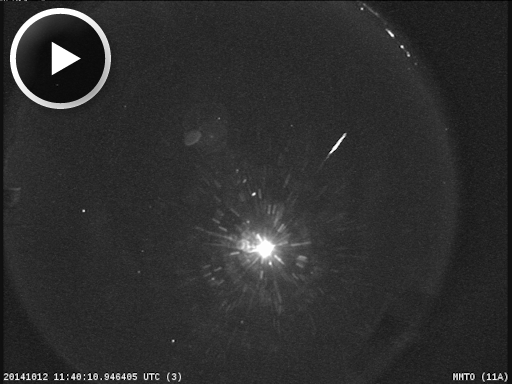
Multiple cameras tracked the meteoroid, which allowed a calculation of its trajectory: It hit Earth's atmosphere traveling 68 km/s (152,000 mph) and fully disintegrated 67.9 km above Earth's surface.
This fireball is a sign that the Orionid meteor shower is about to begin. Every year in mid- to late-October, Earth passes through a stream of debris from Halley's Comet, the parent of the Orionids. For many nights in a row, pre-dawn sky watchers can see meteors streaking out of the constellation Orion, near the Hunter's shoulder. In 2014, forecasters expect the Orionids to peak on Oct. 21-22 with 20 to 25 meteors per hour.
Stay tuned for updates about meteor activity as Earth approaches the heart of the debris stream. Meteor alerts: text, voice