PARTIAL SOLAR ECLIPSE: This Thursday Oct. 23rd, the Moon will pass in front of the sun, off center, producing a partial solar eclipse visible from almost all of North America. Get the full story from Science@NASA.
MONSTER SUNSPOT: The biggest sunspot of the current solar cycle is turning toward Earth. This morning when astronomer Karzaman Ahmad of Malaysia's Langkawi Nagtional Observatory looked through the eyepiece of his solar telescope, he declared AR2192 a "monster" and snapped this picture:
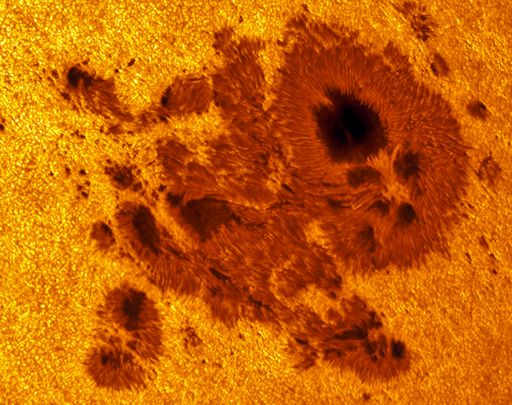
This behemoth active region is 125,000 km wide, almost as big as the planet Jupiter. These dimensions make it an easy target for backyard solar telescopes--hence so many pictures in the realtime photo gallery.
A few days ago, AR2192 unleashed an X1-class solar flare. Since then the sunspot has almost doubled in size and developed an increasingly unstable 'beta-gamma-delta' magnetic field. It would seem to be just a matter of time before another strong explosion occurs. NOAA forecasters estimate at 60% chance of M-class flares and a 20% chance of X-flares on Oct. 21st. Solar flare alerts: text, voice
Realtime Space Weather Photo Gallery
SOLAR WIND SPARKS NORTHERN LIGHTS: A high-speed stream of solar wind is buffeting Earth's magnetic field, sparking bright lights around both poles. "This evening the auroras appeared everywhere," reports Anne Birgitte Fyhn, who photographed the display from a pond on Kvaløya island, Tromsø, Norway:

"They were amazing," she says. "I ran around the pond a couple of times taking pictures from different spots. Finally, I decided to just sit down, look up, and enjoy the show."
High-latitude sky watchers should remain alert for auroras on Oct. 21-22. NOAA forecasters estmate a 45% chance of geomagnetic storms as the solar wind continues to blow. Aurora alerts: text, voice