CRESCENT-SHAPED SUN: The afternoon sun over North America looked a little unusual on Thursday. It was crescent shaped. James W. Young photographed the phenomenon from Wrightwood, California:
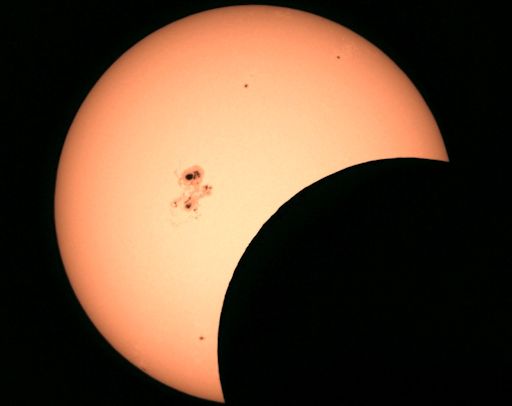
"What a beautiful eclipse," says Young. "Sunspot AR2192 made it extra special."
Millions of sky watchers in Canada, the USA and Mexico saw the Moon pass in front of the sun, covering as much as 70% of the solar disk over Alaska and as little as 12% over Florida. Browse the photo gallery for more views from the eclipse zone.
Realtime Eclipse Photo Gallery
LOTS OF SOLAR FLARES: Solar activity is high. Since the week began, giant sunspot AR2192 has produced 27 C-class solar flares, 9 M-class flares, and 2 X-flares. (What do these classifications mean? Check out the Richter Scale of Solar Flares.) The most powerful eruption so far was an X1.6-category blast on Oct 22nd:
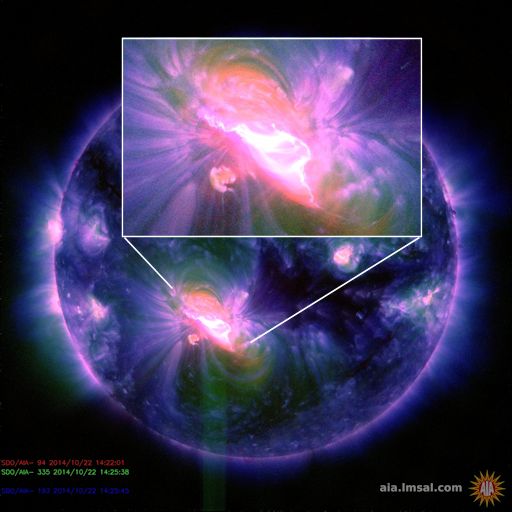
Remarkably, not one of the explosions so far has hurled a significant CME toward Earth. The primary effect of the flares has been to ionize Earth's upper atmosphere, causing a series of short-lived HF radio communications blackouts. Such blackouts may be noticed by amateur radio operators, aviators, and mariners.
Earth-effects could increase in the days ahead. AR2192 has an unstable 'beta-gamma-delta' magnetic field that harbors energy for powerful explosions, and the active region is turning toward Earth. NOAA forecasters estimate a 95% chance of M-class flares and a 55% chance of X-flares during the next 24 hours. Solar flare alerts: text, voice
Because the sunspot is so large--now about as wide as the planet Jupiter--people are beginning to notice it at sunset when the sun is dimmed by clouds or haze. Pilot Brian Whittaker took this picture on Oct. 21st while flying 36,000 ft over Resolute, Nunavut, Canada:

"I was impressed to photograph the giant sunspot as the sun set over Arctic Canada," says Whittaker. "Actually, the sun was temporarily rising because of our great relative speed over the lines of longitude at N75 degrees! Note the green upper rim."
Photographers beware: Do not look at the sun through unfiltered optics. Even when dimmed by clouds or haze, sunlight amplified by camera lenses can cause serious eye damage. If you decide to photograph the low-hanging sun, use your camera's LCD screen for viewfinding. Better yet, buy a solar telescope.
Realtime Space Weather Photo Gallery