CHANCE OF FLARES: Giant sunspot AR2192 is growing again, which means high solar activity is unlikely to subside. NOAA forecasters estimate an 85% chance of M-class flares and a 45% chance of X-flares during the next 24 hours. Solar flare alerts: text, voice
THREE DAYS, THREE X-FLARES: Today (Oct. 26), for the third day in a row, Earth-orbiting satellites detected an X-class solar flare. The X2-category blast came from giant sunspot AR2192, shown here in a Sunday morning sunrise photo from Jean-Baptiste Feldmann of Nuits-Saint-Georges, France:

Recapping the rapid-fire flares: There was an X3 on Oct. 24th (2140 UT), an X1 on Oct 25th (1709 UT), and an X2 on Oct. 22nd (1059 UT). All three of these explosions produced strong HF radio blackouts over the dayside of Earth. In each case, communications were disturbed over a wide area for approximately one hour. Such blackouts may be noticed by amateur radio operators, aviators, and mariners.
Usually, strong flares are acompanied by massive CMEs--billion-ton clouds of electrified gas that billow away from tthe blast site. So far, however, none of the eruptions from AR2192 has produced a major CME. Without a series of CMEs to rattle our planet's magnetic field, there have been no geomagnetic storms nor any widespread auroras. Earth-effects have been limited to radio blackouts. Solar flare alerts: text, voice
Realtime Space Weather Photo Gallery
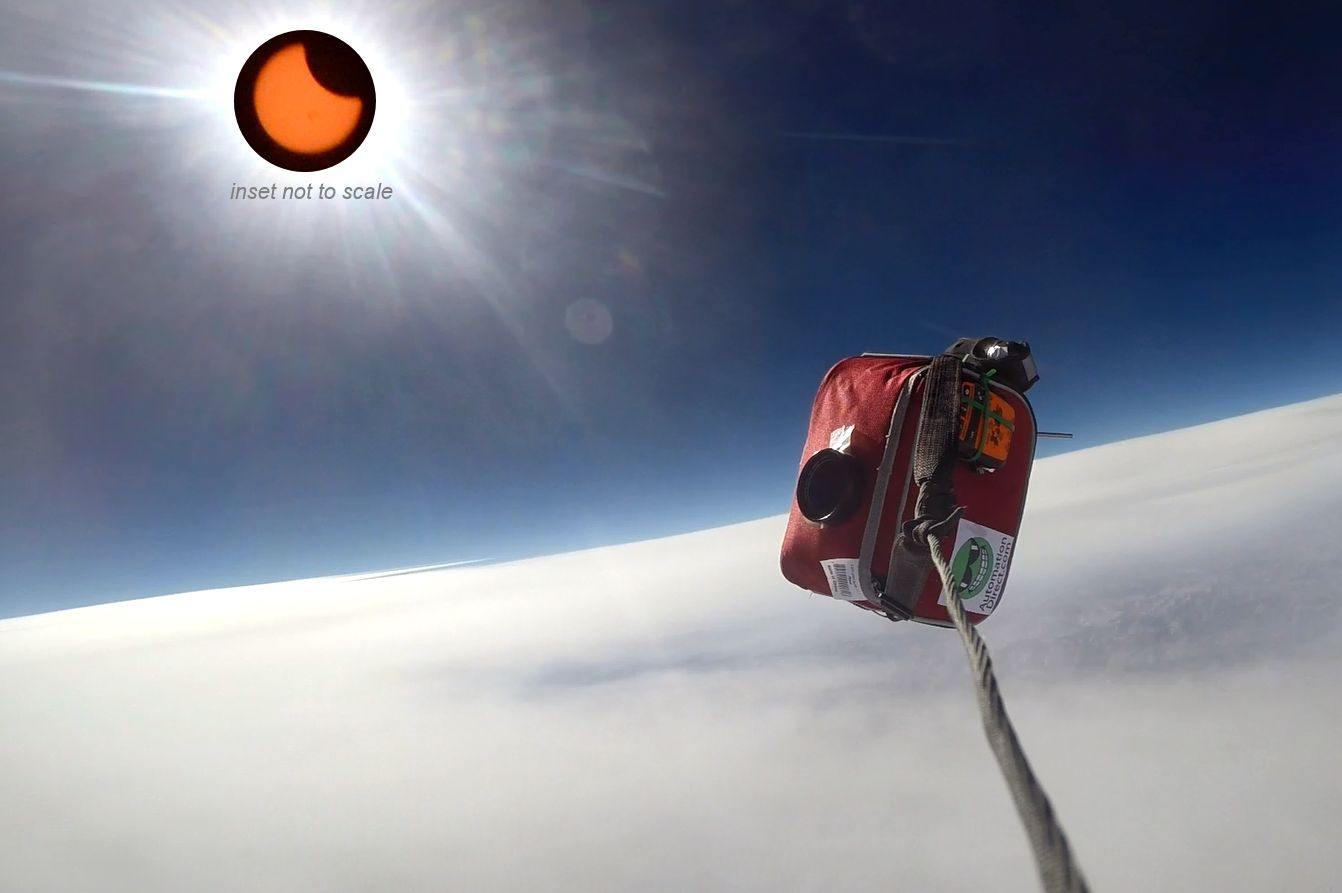
EDGE OF SPACE SOLAR ECLIPSE: There are many beautiful pictures of last Thursday's solar eclipse in the realtime photo gallery. Only these, however, were taken from the stratosphere:

On Oct. 23rd, just as the New Moon was about to pass in front of the sun, the students of Earth to Sky Calculus launched a helium balloon carrying a Nikon D7000 camera. Their goal: to set the record for high-altitude photography of an eclipse. During a two-hour flight to the edge of space, the camera captured 11 images of the crescent sun. The final picture, taken just a split second before the balloon exploded, was GPS-tagged with an altitude of 108,900 feet.
To put this achievement into context, consider the following: Most people who photographed the eclipse carefully mounted their cameras on a rock-solid tripod, or used the precision clock-drive of a telescope to track the sun. The students, however, managed the same trick from an un-stabilized platform, spinning, buffeted by wind, and racing upward to the heavens at 15 mph. Their photos show that DLSR astrophotography from an suborbital helium balloon is possible, and they will surely refine their techniques for even better photos in the future.
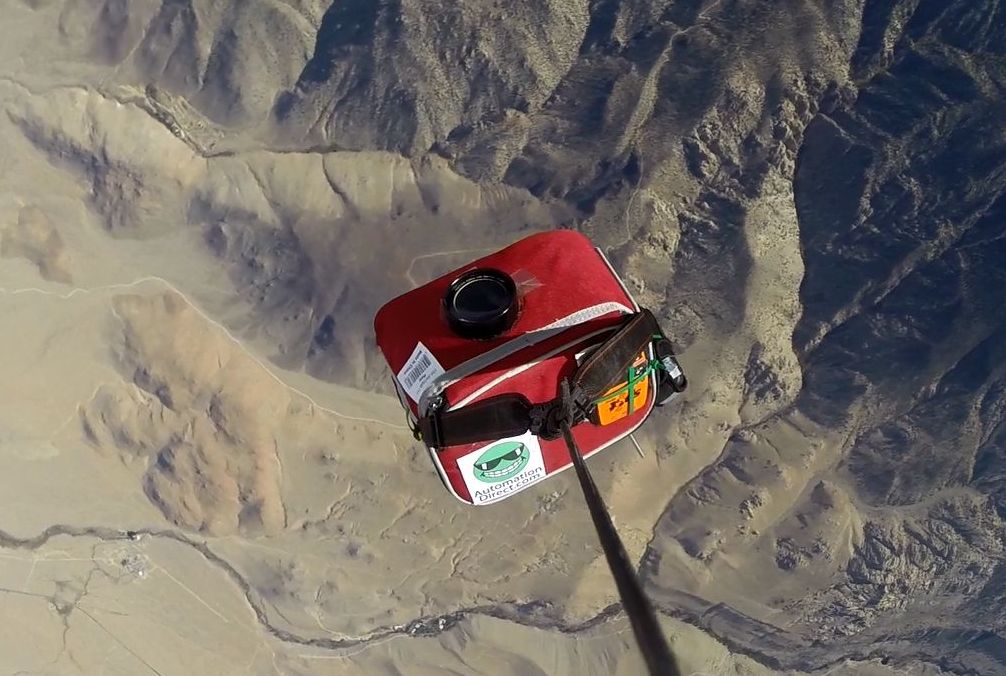
Hey thanks! The students wish to thank AutomationDirect.com for sponsoring this flight. Their $500 contribution paid for the helium and other supplies necessary to get the balloon off the ground. Note the Automation Direct logo in this picture of the payload ascending over the Sierra Nevada mountains of central California:
Another notable picture shows the payload ascending over clouds, which blocked the eclipse at ground level but did not prevent photography from the balloon.
Readers, would you like to sponsor a student research flight and have your logo photographed at the edge of space? Contact Dr. Tony Phillips to get involved.
Realtime Eclipse Photo Gallery