ANOTHER SOLAR FLARE: Active sunspot AR2205 unleashed another strong solar flare today, an impulsive M7-class explosion that peaked around 0947 UT. Radio emissions suggest that a CME raced away from the blast site at 800 km/s (1.8 million mph). Because the sunspot is not facing Earth, the CME should miss our planet. NOAA forecasters estimate a 55% chance of more M-flares in the next 24 hours.
MYSTERY OF THE MISSING SPACE WEATHER BALLOON: On Oct. 23rd, during a partial solar eclipse, the students of Earth to Sky Calculus launched a pair of space weather balloons to measure the effect of the eclipse on the temperature structure of the stratosphere. One balloon collected great data. The other is missing. Visit their Facebook page for the full story.
MOONLIT AURORAS: Earth is passing through a fast-moving stream of solar wind, and this is stirring auroras around the Arctic Circle bright enough to see through the glare of the nearly-full Moon. Tour guide Gunnar Hildonen sends this picture from Tromso, Norway:
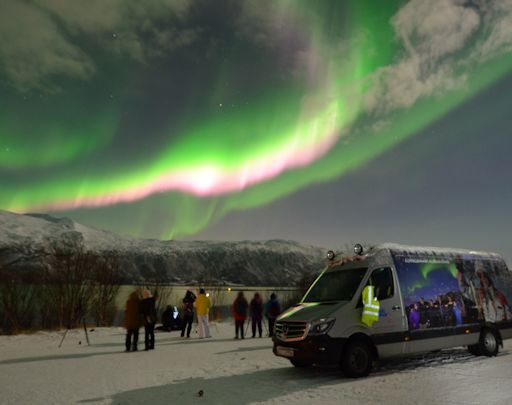
"Lady Aurora just got crazy in the eastern sky," says Hildonen. "Several of my guests were close to crying. It was pink and violet Rock-n-Roll, and it felt like it should never stop. Yes, I am very glad that I have this job."
The moonlight is intensifying ahead of this Thursday's full Moon, but the auroras might be intensifying, too. NOAA forecasters estimate a 40% chance of geomagnetic storms on Nov. 4-5 as the solar wind continues to blow.
EUROPE PREPARES TO LAND ON A COMET: On Nov. 12th, the European Space Agency will attempt something "ridiculously difficult"--that is, landing on a comet. The ESA's Rosetta spacecraft will drop a probe named Philae on Comet 67P/Churyumov–Gerasimenko. "The comet will be moving 40 times faster than a speeding bullet, spinning, shooting out gas and welcoming Rosetta on the surface with boulders, cracks, scarps and possibly meters of dust," says Art Chmielewski, the US Rosetta Project Manager at JPL. A video from NASA previews the landing.
What would you do if you landed on a comet? For his answer, Spaceweather.com reader Luca Savorani created this graphic:
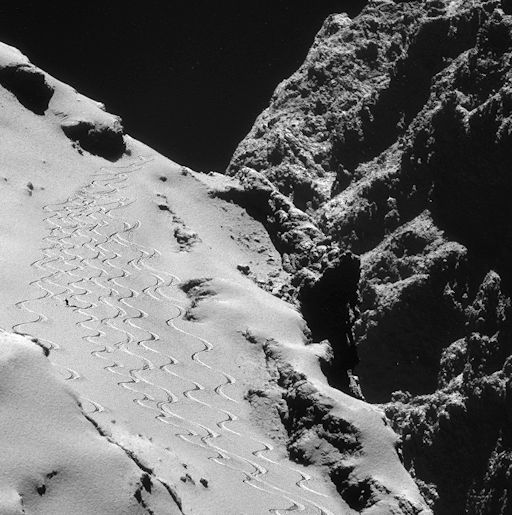
"I added some ski tracks to the dusty slopes of the comet's neck," explains Savorani. "The underlying image was taken by Rosetta's NAVCAM on Oct. 28th."
Skiing on a comet? The idea's not so crazy. Astronauts have seriously discussed the possibility of skiing on the Moon, where thick layers of moondust resemble the powder that coats parts of 67P. All you need are teflon skis.
Realtime Space Weather Photo Gallery