X-FLARE! Active sunspot AR2205 erupted again on Nov. 7th (1726 UT) producing a potent X1-class solar flare and a CME. Extreme UV radiation from the flare ionized the upper layers of Earth's atmosphere, producing a short-lived HF radio blackout on the dayside of our planet. We do not yet know if the CME is Earth-directed. Stay tuned for updates. Solar flare alerts: text, voice
MARTIAN METEOR SHOWER: Today, NASA held a press conference to discuss what happened when Comet Siding Springs buzzed Mars on Oct. 19, 2014. An international fleet of Mars orbiters observed the encounter using a variety of cameras, radars, and other sensors. Among many findings, the highlight was a "spectacular meteor shower" detected by NASA's MAVEN spacecraft. MAVEN did not actually see streaks of light in the Martian atmosphere--the spacecraft was sheltering behind the body of Mars during the comet's flyby. But when MAVEN emerged, it found a glowing layer of Mg+ (a constituent of meteor smoke) floating 150 km above the planet's surface:
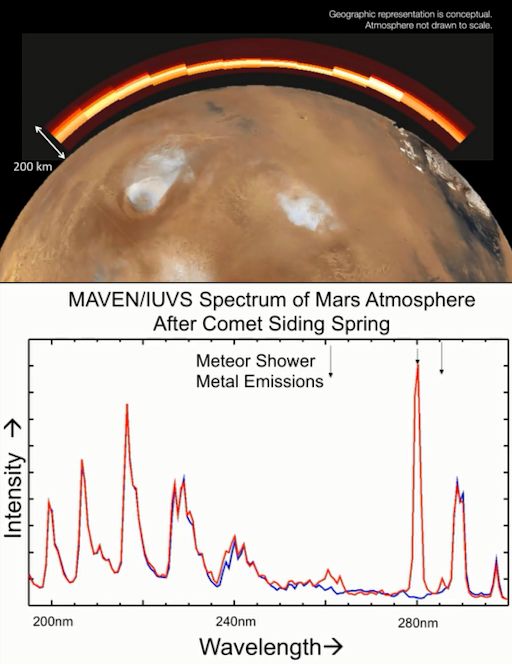
The "smoke" was made of ionized magnesium and other metals shed by the disintegrating meteoroids. The data are consistent with "a few tons of comet dust being deposited in the atmosphere of Mars," says Nick Schneider, the instrument lead for MAVEN's Imaging Ultraviolet Spectrograph at University of Colorado, Boulder. "A human on the surface of Mars might have seen thousands of shooting stars per hour, possibly a meteor storm." He further speculated that the meteor shower would have produced a yellow afterglow in the skies of Mars because the meteor smoke was rich in sodium ions.
Jim Green, the director of NASA's Planetary Science Division in Washington DC says there was a lot more comet dust hitting Mars than researchers expected, pre-flyby. Radars onboard the ESA's Mars Express spacecraft and NASA's Mars Reconnassance Orbiter also detected signs of meteor-related ions. MAVEN and the other spacecraft are continuing to collect data as the atmosphere of Mars recovers from the encounter. Stay tuned for updates.
FULL MOON AURORAS: Auroras are dancing around the Arctic Circle bright enough to see through the glare of the full Moon. The source of the display is a stream of solar wind that is pressing against Earth's magnetic field. Anne Birgitte Fyhn sends this picture, taken last night at moonrise, from Tromsø, Norway:
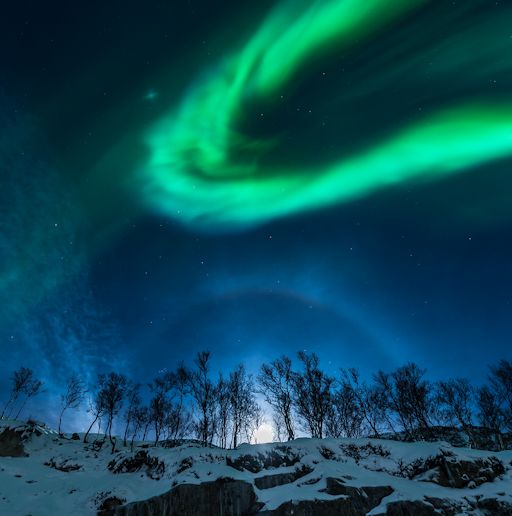
"The sky was partly cloudy, and for a couple of minutes some bright and flashing auroras danced above the full Moon and its halo," says Fyhn.
The circular halo around the Moon is a sign of ice crystals in the clouds. Pencil-shaped crystals catch the rays of the Moon and bend them into a ring 22o in diameter. Normally, icy clouds and moonlight interfere with the visibility of auroras. In this case, however, they added an extra dash of beauty.
More moonlit auroras are in the offing. NOAA forecasters estimate a 30% chance of polar geomagnetic storms on Nov. 7th as the solar wind continues to blow. Aurora alerts: text, voice
UPSIDE DOWN RAINBOWS: 'tis the season for upside-down rainbows. Just this week, one appeared over Sumirago (Varese), Italy:
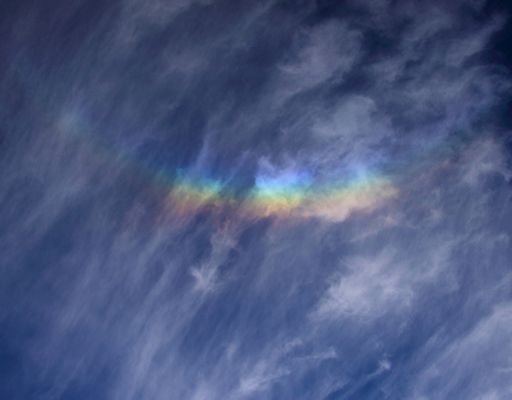
"Bright and multi-colored, it was visible from 10 a.m. until sunset," reports photographer Paolo Bardelli.
The technical name for this phenomenon is circumzenithal arc or "CZA" for short--and it's no rainbow. CZAs are formed by sunlight shining through plate-shaped ice crystals in high clouds. Atmospheric optics expert Les Cowley calls it "the most beautiful of all ice haloes." First timers often describe the CZA as an 'upside down rainbow' and "someone has also likened it to 'a grin in the sky,'" he adds.
Circumzenithal arcs typically appear in late autumn and early winter when the air is icy and the sun is low. "The CZA forms only when sun is less than 32.3° high," notes Cowley. As winter solstice approaches, "upside down rainbows" will become increasingly common. Look for them!
Realtime Space Weather Photo Gallery