WEEKEND FLARES, ALMOST GUARANTEED: Since it emerged last week, sunspot AR2205 has produced more than a dozen strong flares. The active region has an unstable 'beta-gamma-delta' magnetic field that seems all but certain to erupt again this weekend. NOAA forecasters estimate a 70% chance of M-class flares and a 30% chance of X-flares on Nov. 8th. Solar flare alerts: text, voice
X-FLARE AND CME: On Nov. 7th at 1726 UT, Earth-orbiting satellites detected a strong X1.6-class solar flare. The source was sunspot AR2205. NASA's Solar Dynamics Observatory captured the explosion's extreme ultraviolet flash:

Radiation from the flare ionized the upper layers of Earth's atmosphere, producing a short-lived HF radio blackout on the dayside of our planet. This is the sort of disturbance that ham radio operators, aviators or mariners might notice.
The explosion also hurled a CME into space at 600 km/s: movie. As CMEs go, this one is neither fast nor is it heading directly toward Earth. At most, we can expect a glancing blow to Earth's magnetosphere in a few days. Even more likely is no impact at all. NOAA analysts are working on a more precise forecast, so stay tuned. Aurora alerts: text, voice
MARTIAN METEOR SHOWER: Yesterday, NASA held a press conference to discuss what happened when Comet Siding Springs buzzed Mars on Oct. 19, 2014. An international fleet of Mars orbiters observed the encounter using a variety of cameras, radars, and other sensors. Among many findings, the highlight was a "spectacular meteor shower" detected by NASA's MAVEN spacecraft. MAVEN did not actually see streaks of light in the Martian atmosphere--the spacecraft was sheltering behind the body of Mars during the comet's flyby. But when MAVEN emerged, it found a glowing layer of Mg+ (a constituent of meteor smoke) floating 150 km above the planet's surface:
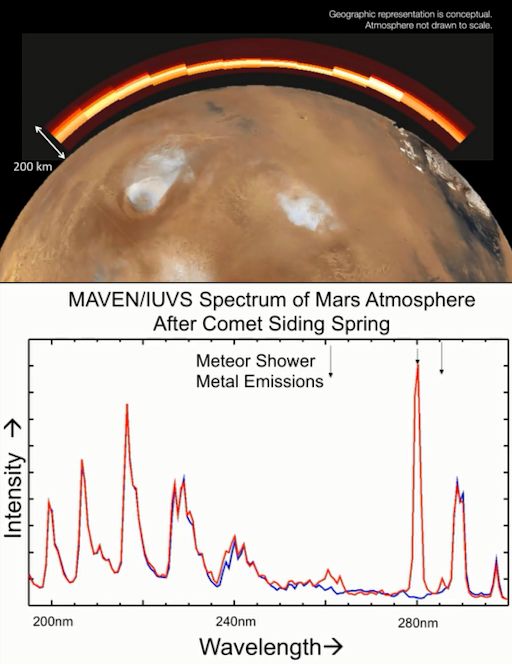
The "smoke" was made of ionized magnesium and other metals shed by the disintegrating meteoroids. The data are consistent with "a few tons of comet dust being deposited in the atmosphere of Mars," says Nick Schneider, the instrument lead for MAVEN's Imaging Ultraviolet Spectrograph at University of Colorado, Boulder. "A human on the surface of Mars might have seen thousands of shooting stars per hour, possibly a meteor storm." He further speculated that the meteor shower would have produced a yellow afterglow in the skies of Mars because the meteor smoke was rich in sodium ions.
Jim Green, the director of NASA's Planetary Science Division in Washington DC says there was a lot more comet dust hitting Mars than researchers expected, pre-flyby. Radars onboard the ESA's Mars Express spacecraft and NASA's Mars Reconnassance Orbiter also detected signs of meteor-related ions. MAVEN and the other spacecraft are continuing to collect data as the atmosphere of Mars recovers from the encounter.
Realtime Space Weather Photo Gallery