CHANCE OF FLARES: How do you make an active sunspot go quiet? Answer: Issue a forecast of "almost certain" flares. That's what we did yesterday, and AR2205 responded with a Saturday of inactivity. Sunday could deliver more action. AR2205 has an unstable 'beta-gamma-delta' magnetic field that harbors energy for strong explosions. NOAA forecasters estimate a 70% chance of M-flares and a 30% chance of X-flares on Nov. 9th. Solar flare alerts: text, voice
CME TARGETS EARTH, AFTER ALL: On Nov. 7th, when an X-flare from AR2205 hurled a CME into space, at first it appeared that the cloud would miss Earth. Follow-up computer modeling by NOAA analysts suggests that the CME might deliver a glancing blow to our planet's magnetic field after all. A complete forecast follows this movie of the eruption recorded by the Solar and Heliospheric Observatory:

The CME left the sun traveling approximately 600 km/s (1.3 million mph) albeit not directly along the sun-Earth line. If the computer models are correct, the outskirts of the cloud should reach Earth mid-day on Nov. 10th (Universal Time). First contact could spark a G2-class geomagnetic storm on Nov. 10th subsiding to G1-class on Nov. 11th. NOAA forecasters are citing storm probabilities as high as 75%.
These storms in the forecast are mild, not extreme, so there is no danger of power outages or communications blackouts. However, the CME impact could spark some beautiful auroras around the Arctic Circle. The lights might even spill across the Canadian border into northern-tier US states such as Maine, Michigan, Minnesota and the Dakotas. Aurora alerts: text, voice
MARTIAN METEOR SHOWER: On Friday, NASA held a press conference to discuss what happened when Comet Siding Springs buzzed Mars on Oct. 19, 2014. An international fleet of Mars orbiters observed the encounter using a variety of cameras, radars, and other sensors. Among many findings, the highlight was a "spectacular meteor shower" detected by NASA's MAVEN spacecraft. MAVEN did not actually see streaks of light in the Martian atmosphere--the spacecraft was sheltering behind the body of Mars during the comet's flyby. But when MAVEN emerged, it found a glowing layer of Mg+ (a constituent of meteor smoke) floating 150 km above the planet's surface:
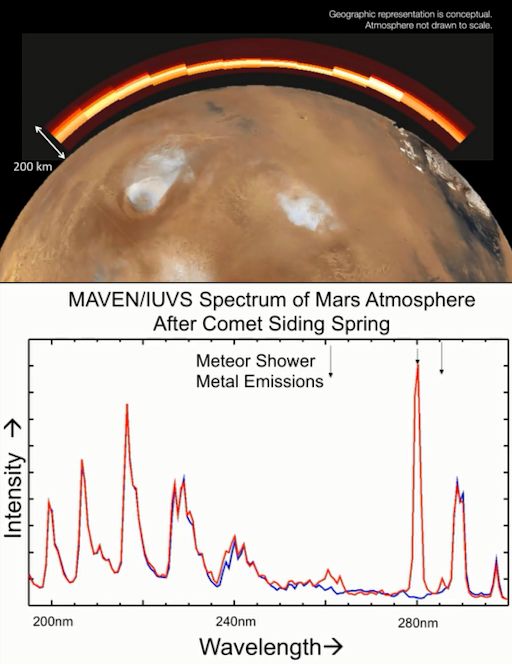
The "smoke" was made of ionized magnesium and other metals shed by the disintegrating meteoroids. The data are consistent with "a few tons of comet dust being deposited in the atmosphere of Mars," says Nick Schneider, the instrument lead for MAVEN's Imaging Ultraviolet Spectrograph at University of Colorado, Boulder. "A human on the surface of Mars might have seen thousands of shooting stars per hour, possibly a meteor storm." He further speculated that the meteor shower would have produced a yellow afterglow in the skies of Mars because the meteor smoke was rich in sodium ions.
Jim Green, the director of NASA's Planetary Science Division in Washington DC says there was a lot more comet dust hitting Mars than researchers expected, pre-flyby. Radars onboard the ESA's Mars Express spacecraft and NASA's Mars Reconnassance Orbiter also detected signs of meteor-related ions. MAVEN and the other spacecraft are continuing to collect data as the atmosphere of Mars recovers from the encounter.
Realtime Space Weather Photo Gallery