OLD SUNSPOT SET TO RETURN: The quieting of sunspot AR2205 has prompted NOAA forecasters to lower the odds of an X-class flare today to only 10%. However, they are raising the odds again tomorrow when old sunspot AR2192 is expected to return from its two-week trip around the farside of the sun. In late October, AR2192 unleashed six intense X-flares. If it still possesses any of its former vigor, the old sunspot could bring a sharp uptick in solar activity. NOAA estimates a 30% chance of X-flares on Nov. 12-13. Solar flare alerts: text, voice
HISTORIC COMET LANDING TOMORROW: The European Space Agency is about to make history: On Nov. 12th, it is going to land on a comet. The action begins Wednesday at 08:35 UT when ESA's Rosetta spacecraft drops a probe named "Philae" onto the core of Comet 67P. This video shows what happens next:

In the past, nations of Earth have landed on planets, moons, and asteroids, but never before on a comet. This is an important and daring first. "A comet is unlike any other planetary body that we've attempted to land on," says Claudia Alexander of the US Rosetta Project at JPL. "Getting Philae down successfully will be an incredible achievement for humankind."
"How hard is this landing?" asks Art Chmielewski, the US Rosetta Project Manager. "Consider this: The comet will be moving 40 times faster than a speeding bullet, spinning, shooting out gas and welcoming Rosetta on the surface with boulders, cracks, scarps and possibly meters of dust!"
Philae will take 7 hours to fall 22.5 km from the spacecraft to the comet--an interval some mission scientists are calling "The Seven Hours of Terror." Confirmation of the landing will reach ground stations on Wednesday at approximately 1600 UT. You can follow the descent as it happens by tuning in to ESA's #CometLanding webcast.
GENTLE IMPACT PRODUCES MINOR GEOMAGNETIC STORM: A CME sideswiped Earth's magnetic field on Nov. 10th. The impact was weak, yet nevertheless sparked a G1-class geomagnetic storm and auroras around the poles. Marketa S. Murray sends this picture from outside Fairbanks, Alaska:
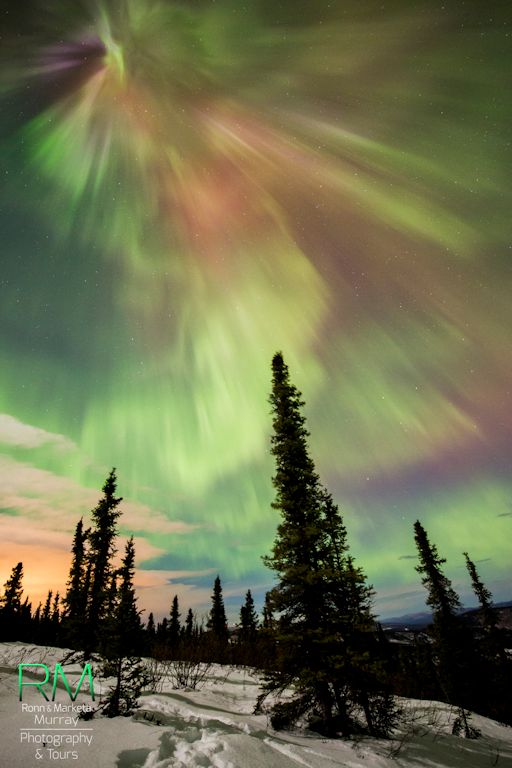
"We some 'Alaska rain' in Fairbanks this morning," says Murray. "Beautiful!"
The CME that sparked the display traveled to Earth at about 600 km/s. As CMEs go, that is slow. Because the storm cloud was relatively plodding, it did not develop a shock wave at its leading edge--hence the weak impact and minor storm.
Geomagnetic unrest should continue around the poles for the next 24 hours as CME effects subside. Arctic sky watchers, remain alert for auroras. Aurora alerts: text, voice
Realtime Space Weather Photo Gallery