BOUNCE-DOWN ON THE SURFACE OF A COMET: ESA's Rosetta spacecraft dropped its lander, Philae, onto the surface of Comet 67P yesterday. Because the lander's harpoons did not latch onto the comet's surface, Philae bounced three times before settling down. This morning, ESA engineers announced that Philae is resting in a stable position and sending its first images from the surface of the comet. ESA plans to issue another update later today. Stay tuned.
OLD SUNSPOT RETURNS: Late last month, the biggest sunspot in nearly 25 years crossed the face of the sun, blasting Earth's upper atmosphere with dozens of solar flares. Today, AR2192 returned, and it is just a shadow of its former self. Karzaman Ahmad of the Langkawi National Observatory in Malaysia photographed the old sunspot emerging over the sun's southeastern limb on Nov. 13th:
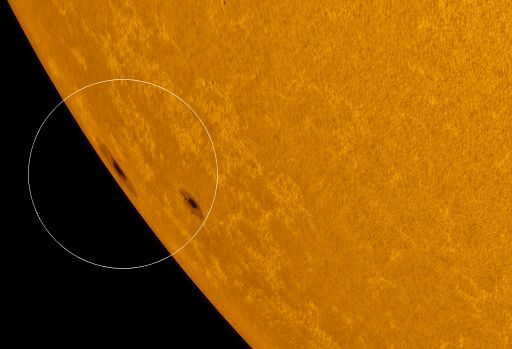
In late October, AR2192 unleashed 6 X-class solar flares and many more M-class flares. Strong HF radio blackouts were a daily occurance, and millions of people glimpsed the great sunspot during a partial solar eclipse.
For the past two weeks, the sunspot has been transiting the farside of the sun. Ahmad's photo shows that it decayed during that time. The waning remains of AR2192 do not appear to pose a threat for strong flares. Solar flare alerts: text, voice
Realtime Space Weather Photo Gallery
RADS ON A PLANE: On Nov. 11th, Tony Phillips of spaceweather.com flew from California across the USA to attend a science communications meeting in Washington DC. As an experiment, he decided to take a radiation sensor onboard the plane. The results were eye-opening. During the apex of his flight to DC, cruising 39,000 feet above the desert between Reno and Phoenix, he recorded a dose rate almost 30 times higher than on the ground below:

There was no solar storm in progress. The extra radiation was just a regular drizzle of cosmic rays reaching down to aviation altitudes. This radiation is ever-present and comes from supernovas, black holes, and other sources across the galaxy.
In a single hour flying between Reno and Phoenix, the passengers on Phillips's flight were exposed to a whole day's worth of ground-level radiation--or about what a person would absorb from an X-ray at the dentist's office. That's not a big deal for an occasional flyer, but as NASA points out, frequent fliers of 100,000 miles or more can accumulate doses equal to 20 chest X-rays or about 100 dental X-rays. Lead aprons, anyone?

The radiation sensor is the same one that Earth to Sky Calculus routinely flies to the stratosphere to measure cosmic rays. It detects X-rays and gamma-rays in the energy range 10 keV to 20 MeV. These energies span the range of medical X-ray machines and airport security scanners. Indeed, when the sensor passed through TSA security at the Reno airport, it began to buzz loudly, signaling a heavy dose of X-rays in the carry-on baggage scanner. TSA agents gathered around the instrument to investigate and they were quite interested when Phillips explained its function. Several wanted to know if they themselves were exposed to radiation in the vicinity of the luggage scanner; a quick survey of the area revealed no leaks.
After boarding the plane, Phillips monitored radiation levels closely. Dose rates tripled within 10 minutes of take-off and remained high for the duration of the flight. This simple experiment shows that space weather can touch us even when the sun is quiet. Imagine what an actual solar storm could do.