LUNAR TRANSIT OF THE SUN: On Saturday, Nov. 22nd, the Moon will pass in front of the sun, producing a partial solar eclipse visible only from Earth orbit. NASA's Solar Dynamics Observatory will record the event, simulated here. Stay tuned for a crescent sun. Solar flare alerts: text, voice
SUB-SUNDOG: Next week's Thanksgiving is the biggest travel holiday of the year in the United States. Millions of people board airplanes and fly long hours to visit friends and family. Dreading the trip? Think of it as a sky watching opportunity. There are some things you can see only through the window of an airplane--like this:
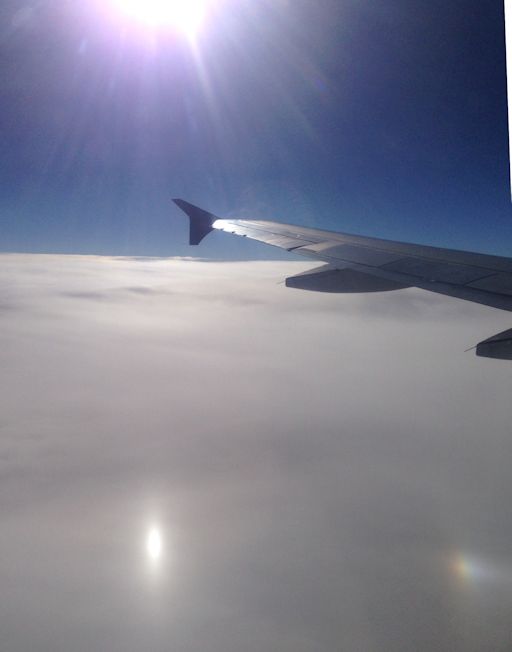
"In the tops of the clouds, I saw a bright reflection of the sun flanked by rainbow-colored sundogs," says Alex Ruege, who snapped the picture on November 14th while he was flying over Phoenix, Arizona.
Atmospheric optics expert Les Cowley explains the apparition: "Look down from the sunny side of an aircraft and you will often see a dazzling reflection of the sun in the clouds. This is a subsun, formed by millions of plate shaped ice crystals acting as mirrors. Sometimes the subsun is flanked by two colorful sub-sundogs. How do they form? Sunlight nearly always bounces up and down inside the thin ice plates before it can emerge. An even number of bounces make a sundog. An odd number makes the sub-sundog. When you see halos always check out the opposite direction – you might see even rarer sights!"
Realtime Space Weather Photo Gallery
RED SPRITES OVER THE ADRIATIC: Summer is the season for sprites, a form of lightning that leaps up from the tops of thunderstorms. This picture, just in from Dubrovnik, a Croatian city on the Adriatic Sea, shows that they can be seen in autumn, too:
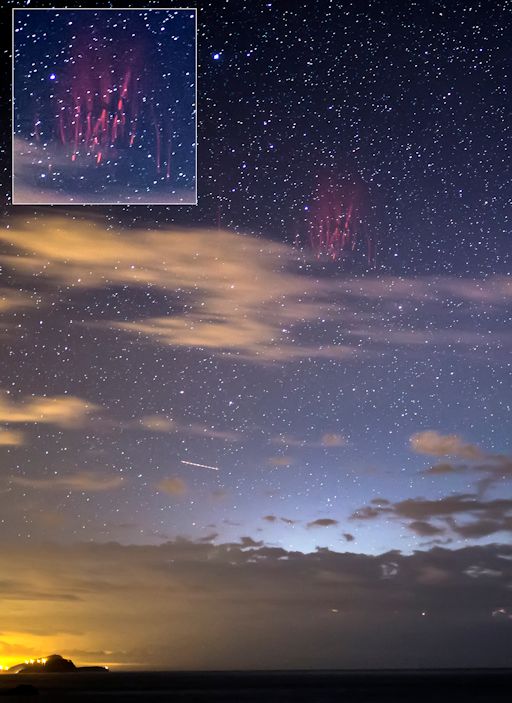
"I was photographing a distant thunderstorm when this red sprite appeared," says Boris Basic of Dubrovnik. "It is a rare upper atmospheric phenomenon."
Inhabiting the upper reaches of Earth's atmosphere alongside noctilucent clouds, meteors, and some auroras, sprites are a true space weather phenomenon. Some researchers believe they are linked to cosmic rays: subatomic particles from deep space striking the top of Earth's atmosphere produce secondary electrons that, in turn, could provide the spark that triggers sprites.
Although sprites have been seen for at least a century, most scientists did not believe they existed until after 1989 when sprites were photographed by cameras onboard the space shuttle. Now "sprite chasers" regularly photograph the upward bolts from their own homes. Give it a try!
Realtime Space Weather Photo Gallery