QUIET WITH A CHANCE OF FLARES: Solar activity has been low for almost a week. Two sunspots, one old and one new, could break the quiet. AR2192 and AR2216 have tangled magnetic fields poised to criss, cross, and explode. NOAA forecasters estimate a 25% chance of an X-flare on Nov. 23rd. Solar flare alerts: text, voice
LUNAR TRANSIT OF THE SUN: Yesterday, Nov. 22nd, the Moon passed in front of the sun off-center, producing a beautiful partial eclipse. No one on Earth saw it, because the lunar transit was visible only from Earth orbit. More than 22,000 miles above the planet's surface, NASA's Solar Dynamics Observatory (SDO) snapped this picture:

Using a bank of 16-megapixel cameras, SDO observed the event at multiple extreme ultraviolet wavelengths. Scan the edge of the Moon in the 171 Å high-resolution image, shown below. The little bumps and irregularities you see are lunar mountains backlit by solar plasma:

Beyond the novelty of observing an eclipse from space, these images have practical value to the SDO science team. The sharp edge of the lunar limb helps researchers measure the in-orbit characteristics of the telescope--e.g., how light diffracts around the telescope's optics and filter support grids. Once these are calibrated, it is possible to correct SDO data for instrumental effects and sharpen the images even more than before.
Realtime Space Weather Photo Gallery
SUB-SUNDOG: Next week's Thanksgiving is the biggest travel holiday of the year in the United States. Millions of people board airplanes and fly long hours to visit friends and family. Dreading the trip? Think of it as a sky watching opportunity. There are some things you can see only through the window of an airplane--like this:
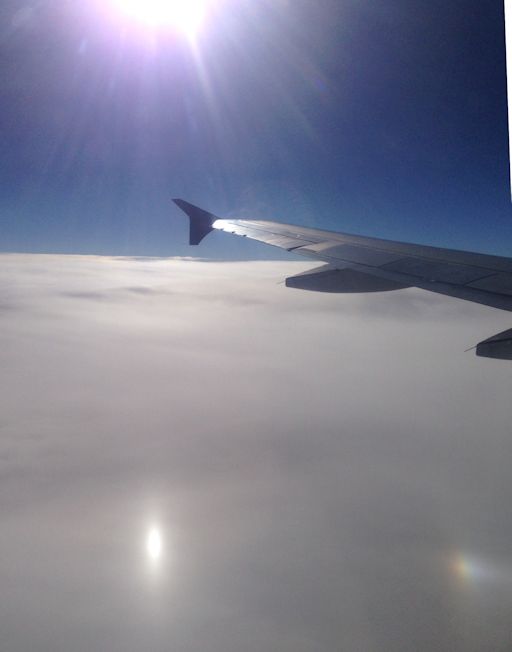
"In the tops of the clouds, I saw a bright reflection of the sun flanked by rainbow-colored sundogs," says Alex Ruege, who snapped the picture on November 14th while he was flying over Phoenix, Arizona.
Atmospheric optics expert Les Cowley explains the apparition: "Look down from the sunny side of an aircraft and you will often see a dazzling reflection of the sun in the clouds. This is a subsun, formed by millions of plate shaped ice crystals acting as mirrors. Sometimes the subsun is flanked by two colorful sub-sundogs. How do they form? Sunlight nearly always bounces up and down inside the thin ice plates before it can emerge. An even number of bounces make a sundog. An odd number makes the sub-sundog. When you see halos always check out the opposite direction – you might see even rarer sights!"
Realtime Space Weather Photo Gallery
RED SPRITES OVER THE ADRIATIC: Summer is the season for sprites, a form of lightning that leaps up from the tops of thunderstorms. This picture, just in from Dubrovnik, a Croatian city on the Adriatic Sea, shows that they can be seen in autumn, too:
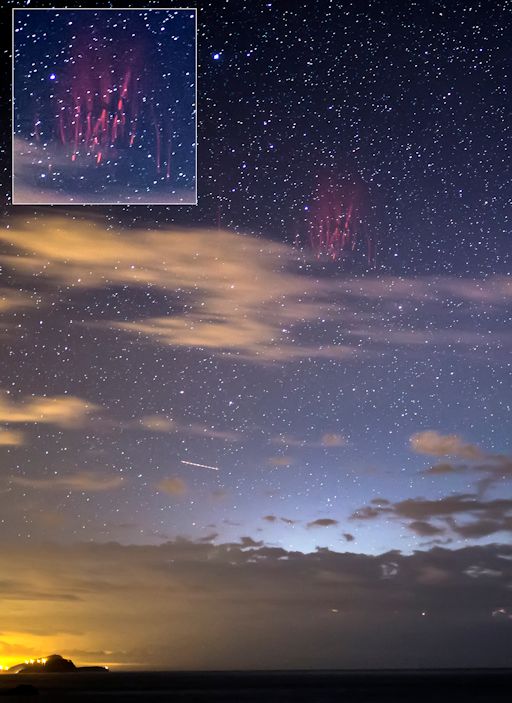
"I was photographing a distant thunderstorm when this red sprite appeared," says Boris Basic of Dubrovnik. "It is a rare upper atmospheric phenomenon."
Inhabiting the upper reaches of Earth's atmosphere alongside noctilucent clouds, meteors, and some auroras, sprites are a true space weather phenomenon. Some researchers believe they are linked to cosmic rays: subatomic particles from deep space striking the top of Earth's atmosphere produce secondary electrons that, in turn, could provide the spark that triggers sprites.
Although sprites have been seen for at least a century, most scientists did not believe they existed until after 1989 when sprites were photographed by cameras onboard the space shuttle. Now "sprite chasers" regularly photograph the upward bolts from their own homes. Give it a try!