THANKSGIVING SKIES: In the USA, Thanksgiving is the bigggest travel holiday of the year. That's good news for sky watchers, because there are some things you can see only from the window of an airplane. Find out what from Science@NASA.
AURORA OUTBURST: On Sunday night, a bright display of auroras erupted around the Arctic Circle. Ole Salomonsen photographed the outburst behind EISCAT's ionospheric radar in Tromsø, Norway:
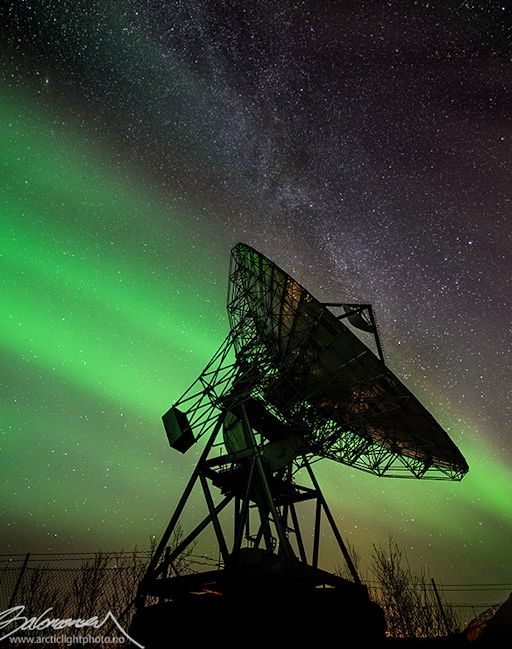
"After a long day of photographing whales at sea, I was looking forward to relaxing in the evening, but Lady aurora invited me out, and I could not resist," says Salomonsen. "After quickly getting new batteries and memory cards for my camera, I went out hunting, this time for the magic emerald light. The entire sky was filled with majestic moving green auroras. At times there were 4 to 5 arcs stretching from east to west next to each other in the sky. This was really amazing to watch!"
Bright auroras are often caused by CME impacts, but there was no CME on Sunday. Instead, the interplanetary magnetic field (IMF) near Earth tilted south. This opened a crack in Earth's magnetosphere. Solar wind poured in to fuel the display. Aurora alerts: text, voice
LUNAR TRANSIT OF THE SUN: On Saturday, Nov. 22nd, the Moon passed in front of the sun, producing a partial solar eclipse. No one on Earth saw it; the lunar transit was visible only from Earth orbit. More than 22,000 miles above our planet's surface, NASA's Solar Dynamics Observatory (SDO) snapped this picture:

Using a bank of 16-megapixel cameras, SDO observed the event at multiple extreme ultraviolet wavelengths. Scan the edge of the Moon in the 171 Å high-resolution image, shown below. The little bumps and irregularities you see are lunar mountains backlit by solar plasma:

Beyond the novelty of observing an eclipse from space, these images have practical value to the SDO science team. The sharp edge of the lunar limb helps researchers measure the in-orbit characteristics of the telescope--e.g., how light diffracts around the telescope's optics and filter support grids. Once these are calibrated, it is possible to correct SDO data for instrumental effects and sharpen the images even more than before.
Realtime Space Weather Photo Gallery