CHANCE OF M-FLARES: NOAA forecasters estimate a 50% chance of M-class solar flares today. There are four possible sources: Sunspots AR2217, AR2219, AR2221 and AR2222 have unstable 'beta-gamma' magnetic fields that harbor energy for moderately strong explosions. Solar flare alerts: text, voice
GEMINID METEOR SHOWER: Earth is entering a stream of gravelly debris from "rock comet" 3200 Phaethon, source of the annual Geminid Geminid meteor shower. Last night, Nov. 30-Dec. 1, NASA's network of all-sky cameras detected three Geminid fireballs over the USA. This specimen from the desert southwest was clearly visible despite the glare from the waxing gibbous Moon:
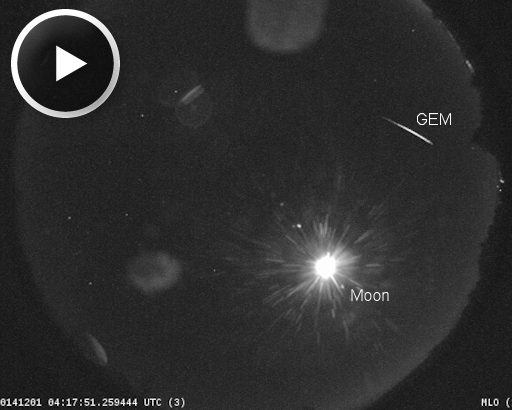
The Geminid hit Earth's atmosphere traveling 32 km/s (72 thousand mph) and disintegrated completely 73 km (45 miles) above Earth's surface. These values are typical of Geminids.
Meteor sightings will increase in the nights ahead as Earth plunges deeper into the debris stream. Forecasters expect peak rates to occur on Dec. 13-14, when dark-sky observers in both hemispheres could see as many as 120 meteors per hour. Stay tuned for updates and, meanwhile, listen for Geminid echoes in the audio feed from our live meteor radar. Meteor alerts: text, voice
Realtime Space Weather Photo Gallery
ELECTRIC-BLUE CLOUDS APPEAR OVER ANTARCTICA: NASA's AIM spacecraft has detected electric-blue clouds forming over Antarctica. These are noctilucent clouds (NLCs), and their apparition marks the beginning of the 2014-2015 season for NLCs in the southern hemisphere.

NLCs are Earth's highest clouds. Seeded by meteor smoke, they form at the edge of space 83 km above Earth's surface. When sunlight hits the tiny ice crystals that make up these clouds, they glow electric blue.
NLCs appear during late spring and summer because that is when the upper atmosphere is ironically coldest, allowing the ice crystals of NLCs to form. Northerners reading this story should remember that it is late spring in Antarctica, so the noctilucent clouds are appearing right on time.
Previous results from AIM have shown that NLCs are like a great "geophysical light bulb." They turn on very year in late spring, reaching almost full intensity over a period of no more than 10 days. At the moment, only a few puffs and wisps of NLCs are visible over Antarctica. By Dec. 10th, the whole continent could be blanketed in electric blue as the bulb begins to glow in earnest. Stay tuned!
WATCH OUT FOR MOON HALOES: The Moon is waxing full this week, which means now is the time to be alert for Moon haloes. This type, photographed last night by D. Thomas of Porthcawl, South Wales, UK, is called a "lunar corona":
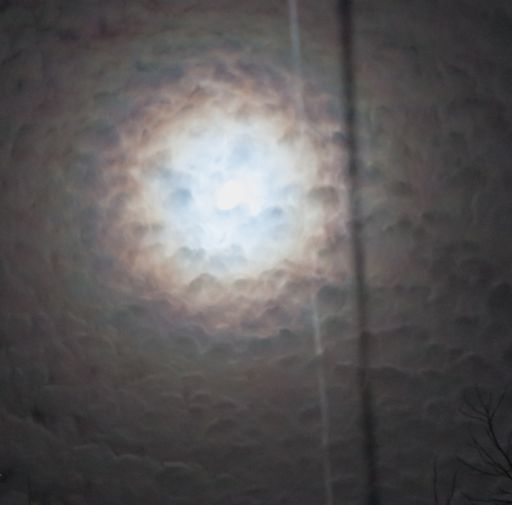
Lunar coronas resemble rainbows but they are not the same. Rainbows are a phenomenon of reflection. Coronas, on the other hand are caused by diffraction. This one is made of moonlight diffracted by tiny droplets of water in passing clouds.
"Not only did the clouds create a brilliant halo around the Moon, but also a passing aeroplanes contrail (white vertical line) cast a shadow (dark vertical line) in the moonlight on clouds below it," points out Thomas. "The rapid motion of the aeroplane gave me no time to set up a tripod, so I snapped the picture using a hand-held Canon EOS 500D."
Rings around the Moon also form when ice crystals drift by, but those are ice halos, and they have a different appearance. Watch for both forms, coronas and ice halos, in the sky and in the realtime photo gallery.