MILD SPACE WEATHER FAVORS ORION LAUNCH: This Thursday, Dec. 4th, NASA will conduct a test launch of Orion, the first spacecraft built for astronauts to travel through deep space since the Apollo missions of the 1960s and 70s. With only a slight 5% chance of X-class solar flares, the space weather forecast favors a trouble-free launch. Terrestrial weather looks good, too. Stay tuned for an historic launch. Solar flare alerts: text, voice
ELECTRIC-BLUE CLOUDS SPREADING OVER ANTARCTICA: Noctilucent clouds (NLCs) around the south pole are spreading and brightening. The latest preliminary image from NASA's AIM spacecraft shows more than 4 times the coverage of just a few days ago:

The season for southern hemisphere noctilucent clouds (NLCs) began on Nov. 22nd with just a few puffy clouds over the frozen continent. Once NLCs first appear, AIM has shown that they rapidly multiply. Indeed, this is happening now, and much of Antarctica soon could be blanketed in electric blue.
Earlier this year, AIM researchers announced a surprising teleconnection: The apparition of NLCs in the southern hemisphere is linked to cold air temperatures thousands of miles away in the northern hemisphere."For example, we found that the winter air temperature in Indianapolis, Indiana, is well correlated with the frequency of noctilucent clouds over Antarctica," says Cora Randall, AIM science team member and Chair of the Dept. of Atmospheric and Oceanic Sciences at the University of Colorado. Other US cities were similarly correlated.
Data from previous seasons show a 2-week time lag between cold outbreaks in the north and changes to NLCs in the south. However, because the 2014-2015 season is less than two weeks old, the correlation is not yet obvious. "I don't expect the northern hemisphere (NH) teleconnection signal to have significant effects on the onset of the southern hemisphere (SH) season for noctilucent clouds," says Randall. "But once planetary wave activity in the SH stratosphere is quiet (should be soon), then I would expect the connections with the NH winter to become more evident."
Randall and a group of colleagues led by Laura Holt of NorthWest Research Associates have just submitted a paper to the Geophysical Research Letters detailing the link between northern winter and southern NLCs. If you have a GRL subscription, keep an eye out for their article entitled "Summertime polar mesospheric clouds linked to wintertime surface cold air outbreaks."
GEMINID METEOR SHOWER: Earth is entering a stream of gravelly debris from "rock comet" 3200 Phaethon, source of the annual Geminid Geminid meteor shower. On the night of Nov. 30-Dec. 1, NASA's network of all-sky cameras detected three Geminid fireballs over the USA. This specimen from the desert southwest was clearly visible despite the glare from the waxing gibbous Moon:
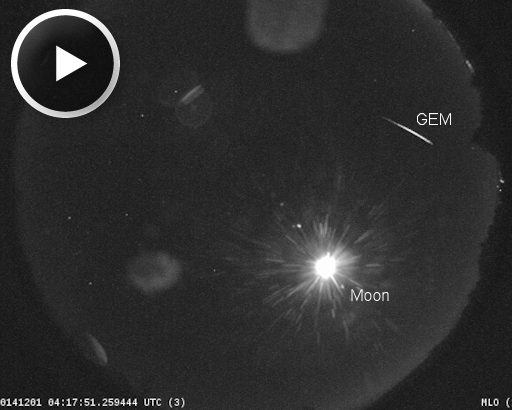
The Geminid hit Earth's atmosphere traveling 32 km/s (72 thousand mph) and disintegrated completely 73 km (45 miles) above Earth's surface. These values are typical of Geminids.
Meteor sightings will increase in the nights ahead as Earth plunges deeper into the debris stream. Forecasters expect peak rates to occur on Dec. 13-14, when dark-sky observers in both hemispheres could see as many as 120 meteors per hour. Stay tuned for updates and, meanwhile, listen for Geminid echoes in the audio feed from our live meteor radar. Meteor alerts: text, voice
Realtime Space Weather Photo Gallery
WATCH OUT FOR MOON HALOES: The Moon is waxing full this week, which means now is the time to be alert for Moon haloes. This type, photographed last night by D. Thomas of Porthcawl, South Wales, UK, is called a "lunar corona":
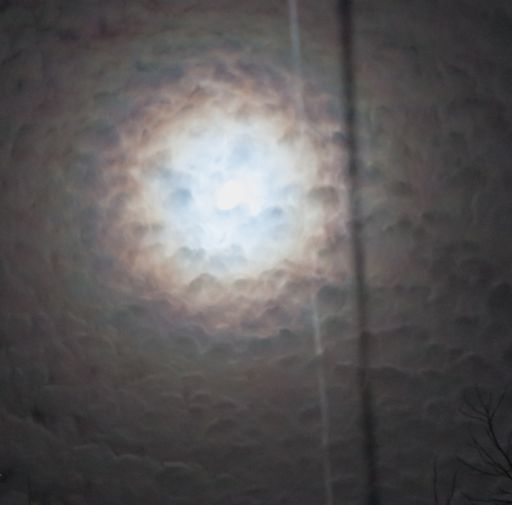
Lunar coronas resemble rainbows but they are not the same. Rainbows are a phenomenon of reflection. Coronas, on the other hand are caused by diffraction. This one is made of moonlight diffracted by tiny droplets of water in passing clouds.
"Not only did the clouds create a brilliant halo around the Moon, but also a passing aeroplanes contrail (white vertical line) cast a shadow (dark vertical line) in the moonlight on clouds below it," points out Thomas. "The rapid motion of the aeroplane gave me no time to set up a tripod, so I snapped the picture using a hand-held Canon EOS 500D."
Rings around the Moon also form when ice crystals drift by, but those are ice halos, and they have a different appearance. Watch for both forms, coronas and ice halos, in the sky and in the realtime photo gallery.