CONGRATULATIONS TO NASA: NASA's new Orion spacecraft, designed to carry astronauts to Mars and beyond, has splashed down in the Pacific Ocean. Today's successful test flight took the spacecraft more than 10 times higher than the International Space Station. Orion circled Earth twice and passed through the inner Van Allen Radiation Belt--a challenging test for any spacecraft. Check NASA's Orion blog for post-flight briefings and more.
ELLIPTICAL MOON HALOS: Luminous halos around the Moon are not unusual. Ice crystals in the air catch moonbeams and bend them into circular rings. On Dec. 3rd, however, Sophie Melanson of Moncton, NB, Canada, witnessed a Moon halo that was not circular, but rather elliptical:
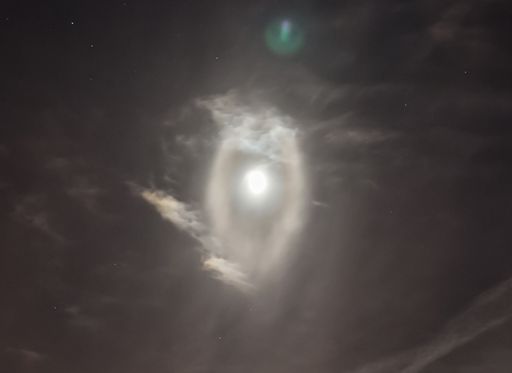
"I was driving to my Intro to Photography class when I noticed this beautiful bright halo around the Moon," says Melanson. "I've seen moon halos many times before, but never this shape. Glad I was able to capture it and share!"
Although physicists have been studying ice halos for decades, not all are understood. "Elliptical halos are one of the puzzles," says atmospheric optics expert Les Cowley. " We can simulate them by invoking hexagonal plate-like crystals topped by almost flat pyramid faces. However, the simulations do not fit very well and such crystals are unphysical. Crystal facets like to form along planes where there are lots of atoms or molecules – almost flat pyramids do not fit the bill at all. Perhaps some peculiar distorted snowflake types instead?"
Whatever causes these elliptical halos, they are beautiful, and more could be in the offing. The Moon is waxing full this week, reaching peak brightness on Dec. 6. Bright moonlight can reveal rare halos that often go unnoticed--elliptical and otherwise. Sky watchers are encouraged to look around the Moon in the nights ahead.
Realtime Space Weather Photo Gallery
M6-CLASS SOLAR FLARE: The magnetic canopy of sunspot AR2222 erupted on Dec. 4th at 18:25 UT, producing an M6-class solar flare. NASA's Solar Dynamics Observatory captured the explosion's extreme ultraviolet flash:
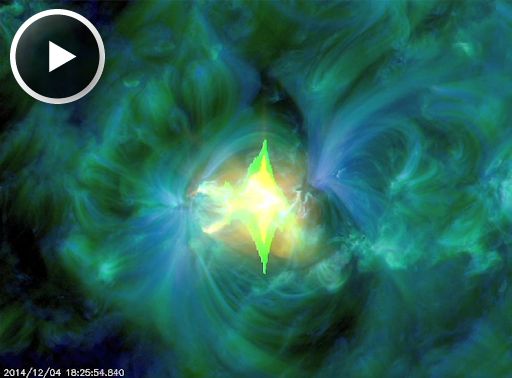
The explosion did not hurl a CME into space, so Earth-effects of the blast were limited to a brief HF radio blackout around the western hemisphere. NOAA forecasters estimate a 40% chance of additional M-flares during the next 24 hours. Solar flare alerts: text, voice
Realtime Space Weather Photo Gallery
THE RETURN OF THE EVENING STAR: For the past two months Venus has been passing behind the sun. Now the second planet is emerging from the glare, setting the stage for The Return of the Evening Star. Yesterday in Spain, the astrophotography group Project Nightflight spotted the silvery light of Venus beaming through the Atlantic sunset:
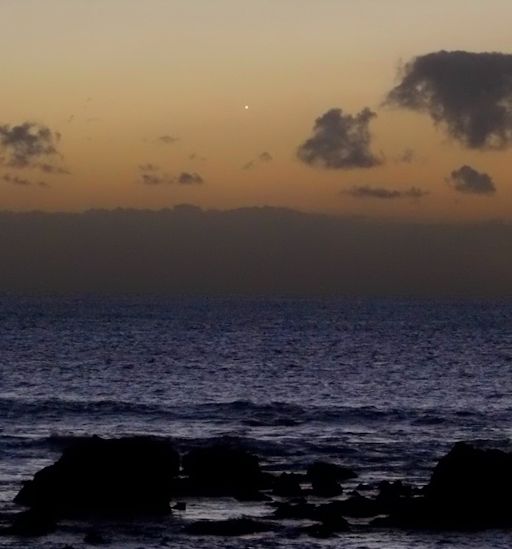
"Venus is beginning a new evening apparition," says Project Nightflight. "After sunset it is very low in the sky and sets quickly. To catch a glimpse of the Evening Star, you will need crisp skies and an unobstructed view of the western horizon. A pair of binoculars will help spot it."
"Visibility will improve during the weeks ahead," they add. "By the end of December, Venus should be plainly visible even from mid northern latitudes."
A date of particular interest is Dec. 22nd when a super-slender 2% crescent Moon will pass Venus in the evening twilight. Astrophotographers, ready your cameras!