GEOMAGNETIC STORM: Arctic sky watchers should be alert for auroras tonight. Earth is passing through a fast-moving (~700 km/s) stream of solar wind, and this is causing G1-class geomagnetic storming around the poles. Aurora alerts: text, voice
GROWING PERIL FOR ASTRONAUTS? NASA's successful test flight of Orion on Dec. 5th heralds a renewed capability to send astronauts into deep space. A paper just published in the journal Space Weather, however, points out a growing peril to future deep space explorers: cosmic rays. The title of the article, penned by Nathan Schwadron of the University of New Hampshire and colleagues from seven other institutions, asks the provocative question, "Does the worsening galactic cosmic ray environment preclude manned deep space exploration?" Using data from a cosmic ray telescope onboard NASA's Lunar Reconnaissance Orbiter, they conclude that while increasing fluxes of cosmic rays "are not a show stopper for long duration missions (e.g., to the Moon, an asteroid, or Mars), galactic cosmic radiation remains a significant and worsening factor that limits mission durations." This figure from their paper shows the number of days a 30 year old astronaut can spend in interplanetary space before they reach their career limit in radiation exposure:

According to the plot, in the year 2014, a 30 year old male flying in a spaceship with 10 g/cm2 of aluminum shielding could spend approximately 700 days in deep space before they reach their radiation dose limit. The same astronaut in the early 1990s could have spent 1000 days in space.
What's going on? Cosmic rays are intensifying. Galactic cosmic rays are a mixture of high-energy photons and subatomic particles accelerated to near-light speed by violent events such as supernova explosions. Astronauts are protected from cosmic rays in part by the sun: solar magnetic fields and the solar wind combine to create a porous 'shield' that fends off energetic particles from outside the solar system. The problem is, as the authors note, "The sun and its solar wind are currently exhibiting extremely low densities and magnetic field strengths, representing states that have never been observed during the Space Age. As a result of the remarkably weak solar activity, we have also observed the highest fluxes of cosmic rays in the Space Age."
The shielding action of the sun is strongest during solar maximum and weakest during solar minimum--hence the 11-year rhythm of the mission duration plot. At the moment we are experiencing Solar Max, which should be a good time for astronauts to fly--but it's not a good time. The solar maximum of 2011-2014 is the weakest in a century, allowing unusual numbers of cosmic rays to penetrate the solar system.
This situation could become even worse if, as some researchers suspect, the sun is entering a long-term phase of the solar cycle characterized by relatively weak maxima and deep, extended minima. In such a future, feeble solar magnetic fields would do an extra-poor job keeping cosmic rays at bay, further reducing the number of days astronauts can travel far from Earth.
To learn more about this interesting research, read the complete article in the online edition of Space Weather.
Realtime Space Weather Photo Gallery
LONG NIGHTS MOON: There's a full Moon tonight, and according to folklore it has a special name: The Long Nights Moon. Winter is tightening its grip on the northern hemisphere, and the nights leading up to the December solstice are long, indeed. They are not so dark, however, thanks to more than 12 hours of illumination from the Long Nights Moon. The scene is especially beautiful in places with a layer of reflective snow. Wherever you live, enjoy the full moonlight!
ELLIPTICAL MOON HALOS: Luminous halos around the Moon are not unusual. Ice crystals in the air catch moonbeams and bend them into circular rings. On Dec. 3rd, however, Sophie Melanson of Moncton, NB, Canada, witnessed a Moon halo that was not circular, but rather elliptical:
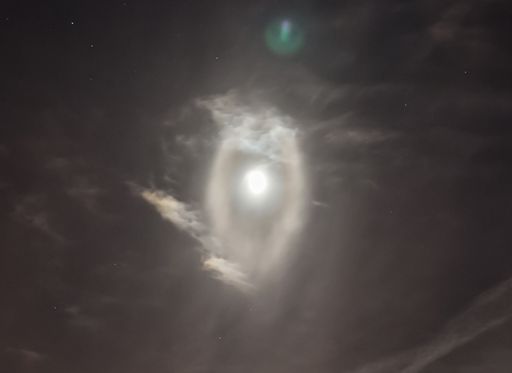
"I was driving to my Intro to Photography class when I noticed this beautiful bright halo around the Moon," says Melanson. "I've seen moon halos many times before, but never this shape. Glad I was able to capture it and share!"
Although physicists have been studying ice halos for decades, not all are understood. "Elliptical halos are one of the puzzles," says atmospheric optics expert Les Cowley. " We can simulate them by invoking hexagonal plate-like crystals topped by almost flat pyramid faces. However, the simulations do not fit very well and such crystals are unphysical. Crystal facets like to form along planes where there are lots of atoms or molecules – almost flat pyramids do not fit the bill at all. Perhaps some peculiar distorted snowflake types instead?"
Whatever causes these elliptical halos, they are beautiful, and more could be in the offing. Bright moonlight can reveal rare halos that often go unnoticed. Look around this weekend's full Moon for luminous rings, arcs, and 'dogs!
Realtime Space Weather Photo Gallery