QUIET WITH A CHANCE OF FLARES: Solar activity has been low for days. The sunspot most likely to break the quiet is AR2230, which has an unstable 'beta-gamma' magnetic field that harbors energy for M-class solar flares. NOAA forecasters estimate a 30% chance of such an explosion on Dec. 11th.Solar flare alerts: text, voice
GEMINID METEOR SHOWER: Geminid meteor activity is picking up as Earth moves deeper into the debris stream of rock comet 3200 Phaethon. Last night alone, NASA's network of all-sky cameras detected 22 Geminid fireballs over the USA. This one, which split the sky above the Kitt Peak National Observatory in Arizona, was easily seen through the glare of the gibbous Moon:
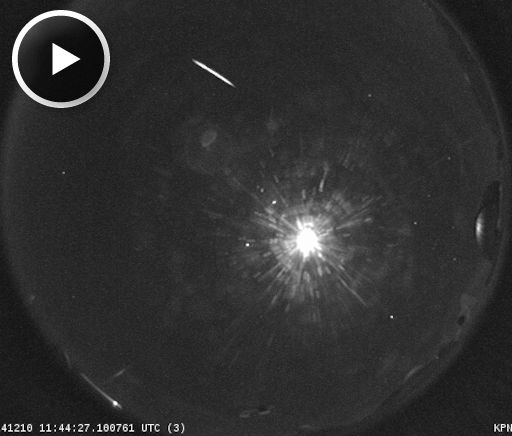
Geminids range in brightness from near-invisibility to shadow-casting fireballs. In recent nights, lunar glare has interfered with the visibility of fainter meteors. This will change in the nights ahead as the Moon wanes and Earth moves deeper into the Geminid debris stream. Forecasters expect the shower to peak on Dec. 13-14 with as many as 120 meteors per hour. Wherever you live, the best time to look is during the hours between midnight and dawn on Saturday and Sunday.
Got clouds? No problem. You can still experience the Geminids by listening for their echoes in this live audio stream from Spaceweather.com's forward scatter meteor radar.
LAUNCH OF THE NEUTRON DETECTOR: For more than a year, the students of Earth to Sky Calculus have been launching Space Weather Buoys to the stratosphere to monitor cosmic radiation. On Dec. 8th, they launched a Space Weather Buoy, version 2.0. In addition to the X-ray/gamma-ray sensors normally flown, the payload also carried a neutron detector:

Neutrons are important because they provide much of the biologically effective radiation dose at altitudes of interest to aviation and space tourism. Low-energy neutrons also cause single-event upsets in aircraft avionics, especially devices that contain Boron 10. Adding a neutron sensor to the Buoy allows the students to monitor this important form of radiation at altitudes ranging from ground level to 120,000 feet.
This was just a test flight to evaluate one possible neutron counter. GPS data indicate that the payload successfully reached the stratosphere and parachuted back to Earth, landing in a remote corner of Death Valley National Park. Soon, a recovery team will collect the payload and the data it contains. Did the detector survive the trip? Did the Buoy detect neutrons in the stratosphere? Stay tuned for answers--and pretty pictures--in the days ahead.
Hey thanks! The students wish to thank the generous folks at MagoGuide.net for sponsoring the flight. MagoGuide is a fantastic travel web site, providing global access to local knowledge to adventurers around the world. Their donation of $500 got this mission off the ground!
Realtime Space Weather Photo Gallery