GEOMAGNETIC STORM: Earth is entering a fast-moving stream of solar wind, and this is causing minor geomagnetic storms around the poles. "We are seeing Northern Lights against a dark blue afternoon sky in the Lofoten Islands of Norway," reports Eric Fokke. Arctic sky watchers should be alert for auroras after local nightfall on Dec. 12-13. Aurora alerts: text, voice
GEMINID METEOR SHOWER: Geminid meteor activity is picking up as Earth moves deeper into the debris stream of rock comet 3200 Phaethon. During the past 48 hours, NASA's network of all-sky cameras have detected 40 Geminid fireballs over the USA. Last night, this one disintegrated inside a Moon halo over the Kitt Peak National Observatory in Arizona:
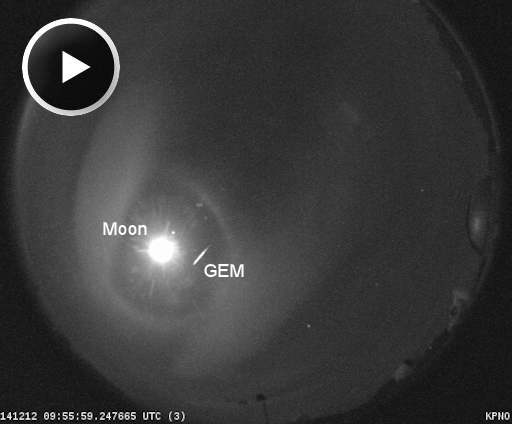
Geminids range in brightness from nearly-invisible specks to shadow-casting fireballs. In recent nights, lunar glare has interfered with the visibility of fainter meteors. This will change over the weekend as the Moon wanes and Earth moves even deeper into the Geminid debris stream. Forecasters expect the shower to peak on Dec. 13-14 with as many as 120 meteors per hour. Wherever you live, the best time to look is during the hours between midnight and dawn on Saturday and Sunday.
Got clouds? No problem. You can still experience the Geminids by listening for their echoes in this live audio stream from Spaceweather.com's forward scatter meteor radar.
THE NITROGEN FRINGE: On Dec. 9th, aurora tour guide Chad Blakley of Sweden's Abisko National Park was warming up inside a Sami hut, when he looked through the door and noticed the snow turning green. "I rushed outside," he says, "and discovered one of the most beautiful aurora displays I had ever seen dancing overhead." In addition to green, there was a rare and remarkable fringe of pink:
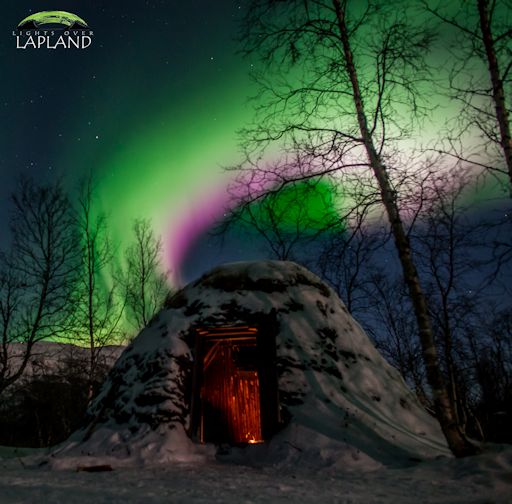
It was the "nitrogen fringe." Most auroras are green--a verdant glow caused by energetic particles from space hitting oxygen atoms 100 km to 300 km above Earth's surface. Seldom-seen pink appears when the energetic particles descend lower than usual, striking nitrogen molecules at the 100 km level and below.
"For almost five minutes, fast-moving pink auroras streaked across the sky," says Blakley. "I have been photographing the Northern Lights for years, and I can honestly say that this was the brightest pink aurora I have ever seen." Using two cameras, he recorded a pair of must-see videos: #1, #2.
Arctic sky watchers should be alert for more pink in the nights ahead. NOAA forecasters estimate a 55% chance of polar geomagnetic storms on Dec. 13-14 as a solar wind stream buffets Earth's magnetic field. Aurora alerts: text, voice
LAUNCH OF THE NEUTRON DETECTOR: For more than a year, the students of Earth to Sky Calculus have been launching Space Weather Buoys to the stratosphere to monitor cosmic radiation. On Dec. 8th, they launched a Space Weather Buoy, version 2.0. In addition to the X-ray/gamma-ray sensors normally flown, the payload also carried a neutron detector:

Neutrons are important because they provide much of the biologically effective radiation dose at altitudes of interest to aviation and space tourism. Low-energy neutrons also cause single-event upsets in aircraft avionics, especially devices that contain Boron 10. Adding a neutron sensor to the Buoy allows the students to monitor this important form of radiation at altitudes ranging from ground level to 120,000 feet.
This was just a test flight to evaluate one possible neutron counter. GPS data indicate that the payload successfully reached the stratosphere and parachuted back to Earth, landing in a remote corner of Death Valley National Park. Soon, a recovery team will collect the payload and the data it contains. Did the detector survive the trip? Did the Buoy detect neutrons in the stratosphere? Stay tuned for answers--and pretty pictures--in the days ahead.
Hey thanks! The students wish to thank the generous folks at MagoGuide.net for sponsoring the flight. MagoGuide is a fantastic travel web site, providing global access to local knowledge to adventurers around the world. Their donation of $500 got this mission off the ground!
EDGE OF SPACE CHRISTMAS CARDS: What do you give to the sky watcher who has everything? How about a Christmas card from the Edge of Space? For only $49.95, the students of Earth to Sky Calculus will fly your holiday greeting or favorite picture to the top of Earth's atmosphere, photograph it, and return the snapshot in time for the holidays. It's a unique gift! The group has previously flown cupcakes, shoes, US presidents, ad banners and telescopes. This holiday magic is performed using suborbital helium balloons. Contact Dr. Tony Phillips for more information.


Realtime Space Weather Photo Gallery