EDGE OF SPACE CHRISTMAS CARDS: What do you give to the sky watcher who has everything? How about a Christmas card from the Edge of Space? For only $49.95, the students of Earth to Sky Calculus will fly your holiday greeting or favorite picture to the top of Earth's atmosphere, photograph it, and return the snapshot in time for Christmas. This holiday magic is performed using suborbital helium balloons. The group has previously flown cupcakes, shoes, US presidents, ad banners and telescopes. Contact Dr. Tony Phillips for more information.


DUAL SPACE STREAMS SPARK 'METEORORA' LIGHT SHOW: This weekend Earth is passing through two space streams--(1) a stream of gravelly debris from rock comet 3200 Phaethon, source of the annual Geminid meteor shower, and (2) a stream of high-speed solar wind from the sun. This double whammy is sparking a mixed display of meteors and auroras around the Arctic Circle. Photographer Frank Olsen sends this 'meteorora' snapshot from Andøya island, Norway:
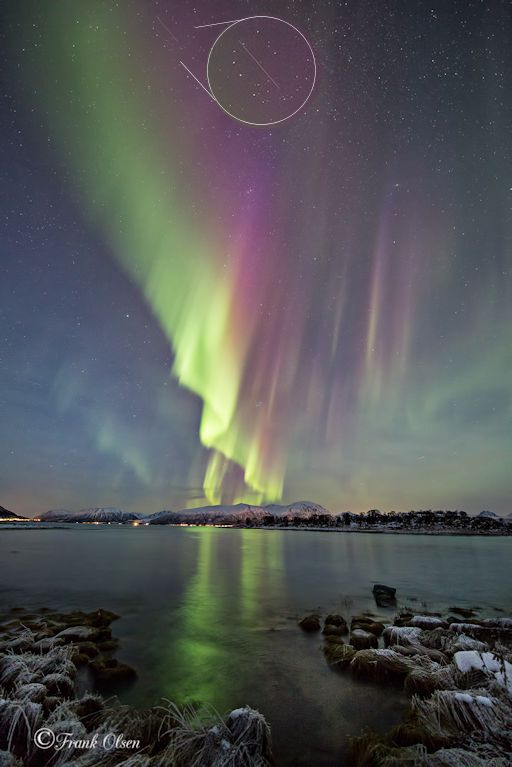
While the visibility of auroras is confined to high latitudes, the Geminids can be seen anywhere. Forecasters expect the shower to peak on Dec. 13-14 with as many as 120 meteors per hour. Wherever you live, the best time to look is during the hours between 10 pm Saturday and dawn on Sunday (local time).
Got clouds? No problem. You can still experience the Geminids by listening for their echoes in this live audio stream from Spaceweather.com's forward scatter meteor radar.
NEUTRONS DETECTED IN THE STRATOSPHERE: On Dec. 8th, using a suborbital helium balloon, the students of Earth to Sky Calculus launched new type of Space Weather Buoy to the stratosphere. Unlike previous buoys, which measured only X-rays and gamma-rays, Space Weather Buoy 2.0 is also sensitive to neutrons. This just in: The flight was a success. To learn about the results, scroll past this photo taken by an onboard camera as the sun was setting at 95,700 feet:

The payload was recovered intact from its landing site near the Eureka Dunes of Death Valley National Park. The neutron sensor returned full of data. Students are still working the numbers, and complete results are not ready to be shared. However, we can say this much now: An abundance of neutrons were detected during the 2 hour flight. Peak rates reached 240 neutrons per minute, compared to ~0 neutrons per minute at ground level.
Neutrons are an important form of cosmic radiation because they provide much of the biologically effective radiation dose at altitudes of interest to aviation and space tourism. Low-energy neutrons also cause single-event upsets in aircraft avionics, especially devices that contain Boron 10. Adding a neutron sensor to the Space Weather Buoy allows the students to monitor this type of radiation at altitudes ranging from ground level to 120,000 feet.
Hey thanks! The students wish to thank the generous folks at MagoGuide.net for sponsoring the flight. Their logo can be seen atop the payload as it ascended above the snowy Sierra Nevadas of centtral Californiia:

MagoGuide is a fantastic travel web site, providing global access to local knowledge to adventurers around the world. Their donation of $500 got this mission off the ground. Thanks again!
Potential sponsors, if you would like to support Earth to Sky Calculus and fly your logo to the edge of space, please contact Dr. Tony Phillips to make arrangements.
Realtime Space Weather Photo Gallery