WEEKEND MAGNETIC STORMS? NOAA forecasters estimate a 60% to 65% chance of minor geomagnetic storms this weekend when a pair of CMEs is expected to sideswipe Earth's magnetic field. High-latitude sky watchers should be alert for auroras after nightfall. Aurora alerts: text, voice
X-FLARE (UPDATED): Big sunspot AR2242 erupted on Saturday, Dec. 20th @ 00:27 UT, producing an intense X1.8-class solar flare. NASA's Solar Dynamics Observatory captured the explosion's extreme ultraviolet flash:
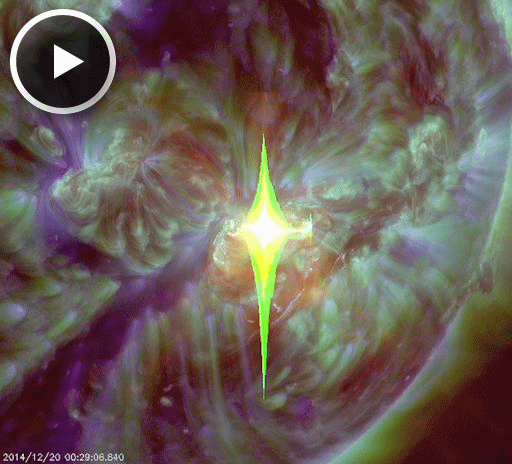
A pulse of X-rays and UV radiation from the flare reached Earth minutes after the explosion. This "solar EMP" ionized our planet's upper atmosphere and blacked out HF radio communications over Australia and the South Pacific. Below 10 MHz, transmissions were strongly attenuated for more than two hours.
The explosion also hurled a CME into space. Click to view a movie of the cloud as recorded by the Solar and Heliospheric Observatory:

Although the instigating flare was Earth-directed, it appears that the CME is not. The bulk of the cloud will sail far south of he sun-Earth line, missing our planet. Solar flare alerts: text, voice
Realtime Space Weather Photo Gallery
RADS ON A PLANE, CONTINUED: Regular readers may remember last month's reports by Dr. Tony Phillips of radiation measurements inside commercial airplanes. During a cross-country trip between Reno NV and Washington DC, he absorbed a dose of ionizing radiation equal to about 3 dental x-rays.
However, not every trip is so "radioactive." On Dec. 17th, he flew from Reno to San Francisco--a short hop over the Sierras to attend the American Geophysical Union meeting--and the dose was much less. These curves show his measurements during the flight:

Compared to last month's travel, there was relatively little radiation on this flight. From take-off to landing, the total dose was only about 3% of a dental X-ray -- a hundred times less than before.
Why so little? For one thing, the flight was brief, less than an hour long. Moreover, it was low. The cruising altitude of the small commuter jet was only 26,000 feet compared to as much as 39,000 feet for last month's cross-country flights. When it comes to "rads on a plane," altitude matters. The source of the radiation is cosmic rays from space; the closer you are to space, the more radiation you are going to absorb. Short, low flights like the Reno to San Francisco hop are best for avoiding exposure.
The data come from a pair of radiation detectors routinely flown to the stratosphere onboard Earth to Sky Calculus Space Weather Buoys. The pager-sized devices are sensitive to ionizing radiation such as X-rays and gamma-rays in the energy range 10 keV to 20 MeV. Ideally, the two detectors should register the same dose rates throughout the flight. Slight differences between the two curves are an indication of the uncertainty in the measurements.
It is important to note that the sensors Phillips carried onboard the plane do not detect one of the most important forms of radiation: neutrons. Neutrons provide much of the biologically effective radiation dose at altitudes of interest to aviation and space tourism. To account for these uncharged particles, the doses discussed above should be doubled or tripled. To improve our estimates of the total dose rate, the students of Earth to Sky Calculus are evaluating neutron detectors for future balloon missions and plane flights.
Realtime Space Weather Photo Gallery