GEOMAGNETIC UNREST: A fast stream of solar wind is buffeting Earth's magnetic field, prompting NOAA forecasters to raise the odds of a polar geomagnetic storm today to 35%. Arctic sky watchers should be alert for auroras. Aurora alerts: text, voice
CHRISTMAS COMET: Is there a cylindrical package under your Christmas tree? Open it now. A small telescope is all you need to see Comet Lovejoy (C/2014 Q2). Discovered just last August by Terry Lovejoy in Australia, the green comet is brightening faster than expected as it moves into northern skies just in time for Christmas. Trace the comet's tail down the page for more information:
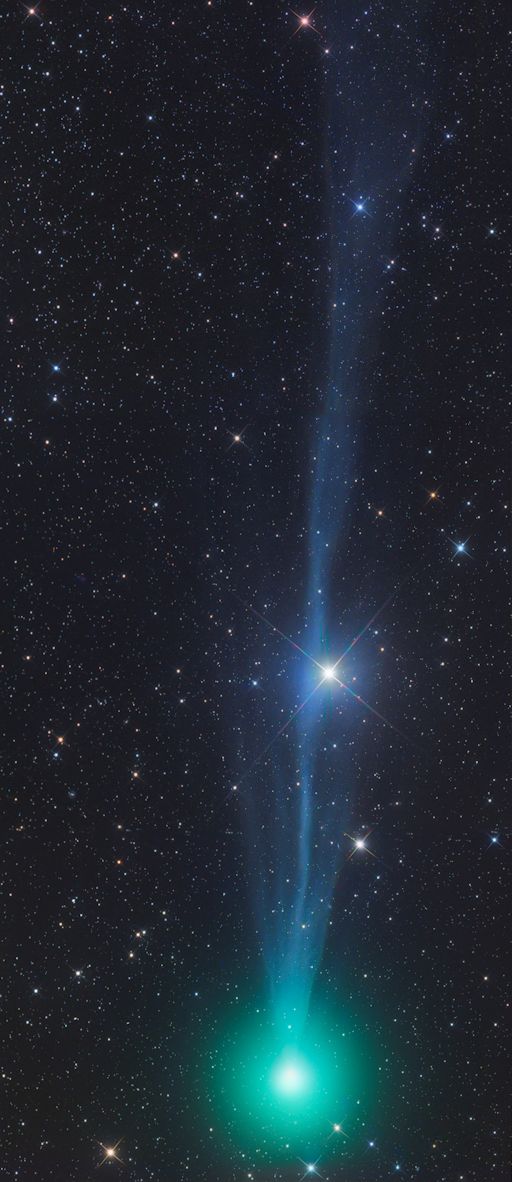
Gerald Rhemann took this picture on Dec. 21st using a remotely-operated telescope in Namibia. The comet's sinuous blue ion tail contrasts beautifully with its puffy green atmosphere. The colors come from ionized carbon monoxide (CO+) and diatomic carbon (C2), which glow blue and green, respectively, in the near-vacuum of interplanetary space.
"Last night (Dec. 23rd), the comet was easy to see in binoculars as a 5th magnitude fuzzy star," reports Alan Dyer of New Mexico. "I could just see the comet naked eye knowing exactly where to look south of Orion in the constellation Columba the dove."
Where is that? These finder charts from Sky and Telescope can help you find the comet. Better yet, if that cylindrical object is a GOTO telescope, just plug in the comet's coordinates and let the telecope find it for you.
URSID METEOR OUTBURST: Normally the Ursid meteor shower, which peaks each year on Dec. 21-23, is a minor event, producing no more than about 10 meteors per hour. 2014, however, was different. "The Canadian Meteor Orbit Radar (CMOR) detected a significant outburst near 0 UT on Dec 23rd," reports Peter Brown, director of the Centre for Planetary Science and Exploration at the University of Western Ontario. Scroll past this radar map of the Ursid radiant for more information:

"In all," he says, "we recorded close to 100 Ursid orbits with CMOR during the 1.5 hours of the outburst (from 2315 UT Dec 22 – 0045 Dec 23). This was more than a factor of two above any other Ursid outburst CMOR has recorded in the last dozen years. The radar map shows a very tight cluster of Ursids from the 1.5 hour outburst 'pouring' right out of the bowl of the Little Dipper."
Ursid meteors are debris from parent Comet 8P/Tuttle. The outburst was predicted by astronomer Jérémie Vaubaillon, whose computer models suggested Earth might cross an old filament of comet dust shed by 8P/Tuttle, causing a surge in meteors around 0 UT on Dec. 23rd. Solar flare alerts: text, voice
Realtime Space Weather Photo Gallery