QUIET SUN: With no sunspots actively flaring, the sun is quiet and solar activity is low. NOAA forecasters estimate a slight 5% chance of X-flares during the next 24 hours. Solar flare alerts: text, voice
SUDDEN DIP IN COSMIC RAYS: Every day, Earth is bombarded by galactic cosmic rays--subatomic particles accelerated to high energies by distant supernovas, stellar flares, and other explosions. On Dec. 21st, ground-based neutron monitors detected a sudden decrease in this cosmic radiation. The following plot from the Oulu Cosmic Ray Station in Finland shows the change:

What happened? Over a 48-hour period beginning on Dec. 21st, a series of three CMEs swept past Earth, delivering glancing blows to our planet's magnetosphere. These CMEs swept aside many of the cosmic rays that would normally bombard our planet. The dip in cosmic rays is called a "Forbush Decrease," named after physicist Scott E. Forbush who first described it in the 20th century.
The ongoing Forbush Decrease is producing some of the lowest radiation levels of the current solar cycle. This is good news for airline passengers, pilots, flight attendants and astronauts, all of whom absorb cosmic rays during their travels.
To investigate how the Forbush Decrease is propagating through the atmosphere, the students of Earth to Sky Calculus gathered on Christmas Eve to launch a Space Weather Buoy:

The Buoy (inset) carried a pair of X-ray/gamma-ray sensors, a cryogenic thermometer, two GPS altimeters, a GPS tracker and three video cameras to record the trip. If everything worked as planned, the Buoy will have recorded a complete profile of ionizing radiation from ground level to 110,000 feet. The students will be able to compare the current radiation profile with dozens of previous profiles measured since 2013.
According to GPS telemetry, the payload traveled to the stratosphere and parachuted back to Earth on Dec. 24th. A recovery team is hiking to the remote landing site today, Dec. 26th. Stay tuned for data and footage.
Realtime Space Weather Photo Gallery
HOLIDAY LIGHTS: A stream of solar wind is bufeting Earths magnetic field, and this is causing geomagnetic unrest around the poles. Last night around the Arctic Circle, Christmas carolers and last minute gift-givers witnessed a beautiful display of holiday lights:
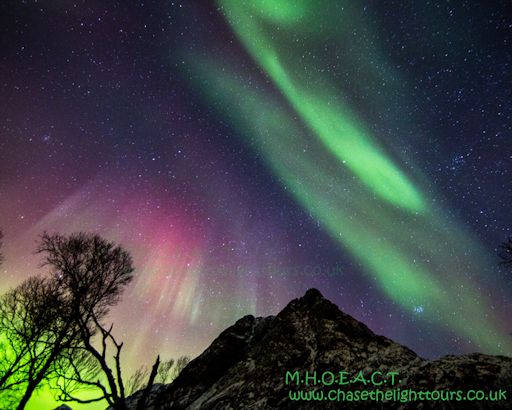
"Vi var ute og leverte julegaver, bare måtte stoppe litt... 5min ble 5timer....," says aurora tour guide Marianne Bergli, who photographed the display in Tromsø, Norway. "God jul alle sammen." Translated: "We were out delivering Christmas gifts and just had to stop a bit ... 5 minutes became 5 hours. Merry Christmas everyone!"
The show's not over. NOAA forecasters estimate a 35% chance of polar geomagnetic storms on Dec. 25th as the solar wind continues to blow. Browse the gallery for latest images from around the Arctic Circle. Aurora alerts: text, voice