WAITING FOR THE FIRST FLARE OF 2015: Solar flares are unpredictable. However, we know where the first flare of the New Year will probably come from: AR2253. The fast-growing sunspot has doubled in size since yesterday, and it has a 'beta-gamma' magnetic field that harbors energy for moderately strong explosions. NOAA forecasters estimate a 25% chance of M-class flares on New Year's Day. Solar flare alerts: text, voice


AURORAS FOR LUNCH: It's not often that you can look out the window during lunch and see auroras cutting across the blue sky. It happened yesterday in Svalbard, a Norwegian archipelago in the Arctic Ocean:
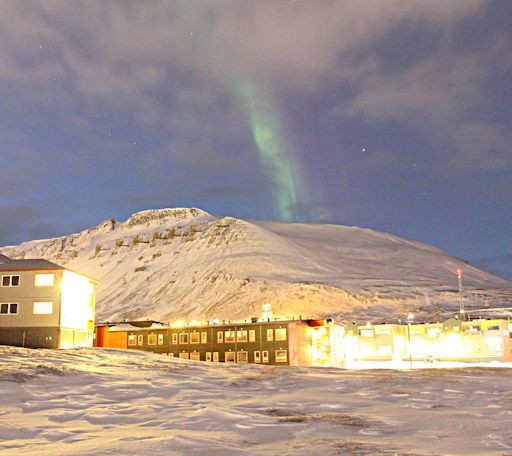
"This was our first observation of a *dayside* aurora," reports Robert Chalmas of Longyearbyen, Svalbard. "It happened between 12:30 and 13:30 local time with the sun just 12o below the horizon. This kind of aurora can be observed only at very high latitudes. It is not as spectacular as nightside auroras, but it has a special beauty all its own."
Auroras could be on the menu again today. Earth is inside a high-speed stream of solar wind that is sparking bright lights around the Arctic Circle. NOAA forecasters estimate a 45% chance of polar geomagnetic storms on Jan. 1st. Aurora alerts: text, voice
THE INCREDIBLE TAIL OF COMET LOVEJOY: Warning, looking at this picture might cause you to buy a telescope. Behold bright Comet Lovejoy (C/2014 Q2), photographed by amateur astronomer Gerald Rhemann on Dec. 23rd:
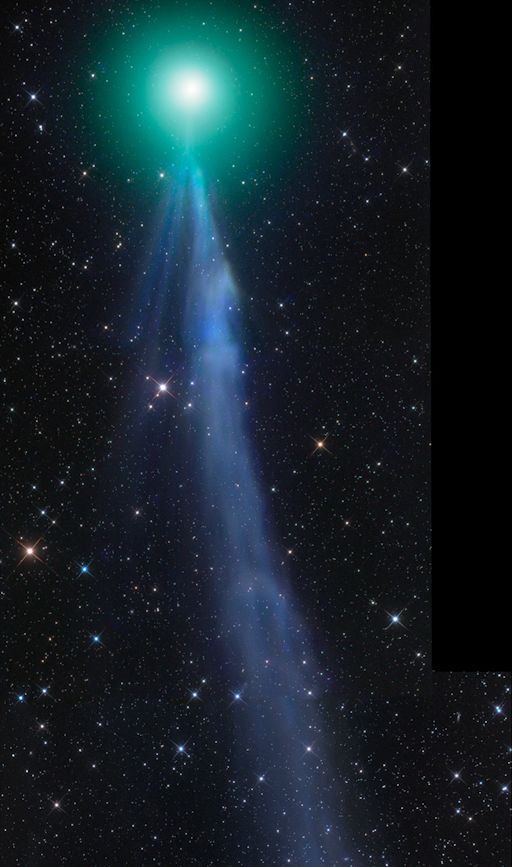
Rhemann used a 12-inch remotely controlled telescope in Namibia to photograph the comet on Dec. 23rd. Lovejoy's sinuous blue tail was so long (more than 6 degrees of arc) he couldn't fit it into a single field of view. "I had to combine six frames," he says. In fact, it is even too big for this web page. Click on the truncated tail, above, to see the whole thing.

He took the picture more than a week ago--and the comet is significantly brighter now. Observers around the world are saying they can see it with the unaided eye from dark sky sites. The comet is shining like a 5th magnitude star, and is expected to double in brightness by mid-January. To the naked eye, it looks like a green fuzzball. Mid-sized backyard telescopes reveal the comet's magnificent blue tail.
Observers should look for the comet passing through the constellation Lepus the Hare south of Orion. Consult these finder charts from Sky & Telescope. For accurate pointing of telescopes, an ephemeris from the Minor Planet Center is available.
SUDDEN DECREASE IN COSMIC RAYS: Every day, Earth is bombarded by galactic cosmic rays--subatomic particles accelerated to high energies by distant supernovas, stellar flares, and other explosions. On Dec. 21st, ground-based neutron monitors detected a sudden decrease in this cosmic radiation:
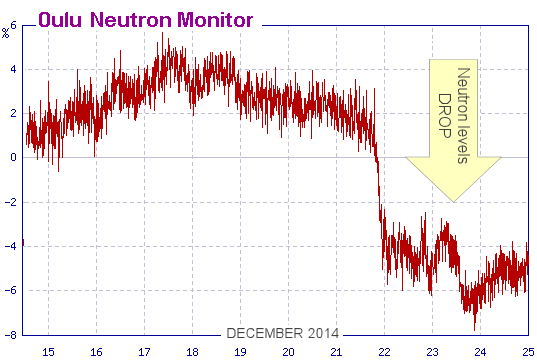
What happened? Over a 48-hour period beginning on Dec. 21st, a series of three CMEs passed by Earth, sweeping aside many of the cosmic rays that would normally bombard our planet. The clearing action of the CMEs produced some of the lowest radiation levels of the current solar cycle. Events like this (called "Forbush Decreases") are of considerable interest to anyone who flies on a plane. Airline passengers, pilots, and flight attendants all absorb cosmic rays during their travels at altitudes above ~20,000 feet.
To investigate how the Forbush Decrease propagated through the atmosphere, Spaceweather.com and the students of Earth to Sky Calculus launched a pair of radiation sensors to the stratosphere. Carried aloft by a helium balloon, their "Space Weather Buoy" reached an altitude of 117,900 ft. This photo was taken by a BuoyCam just seconds before the balloon exploded:
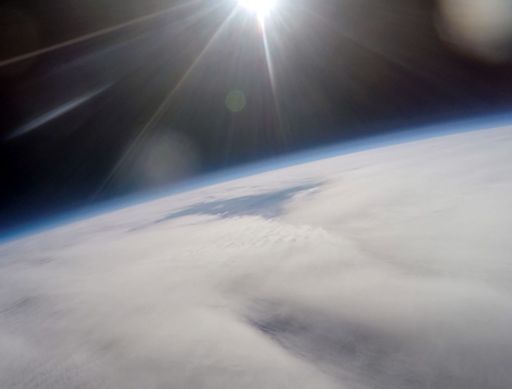
The payload parachuted back to Earth and landed in the Grapevine Mountains of Nevada (not far from Death Valley National Park) on Dec. 24th. A student-canine team have since entered the wilderness and recovered the payload. First impressions: The Buoy took some great pictures and recorded a complete profile of ionizing radiation from ground level to the stratosphere. The students will be able to compare these data with dozens of previous profiles measured since 2013 and, thus, discover the effect of the Forbush Decrease on altitudes of interest to aviation and space tourism. Stay tuned for updates.
Hey thanks! The students wish to thank Gary Worrell of the Johns Hopkins University Applied Physics Lab for sponsoring this flight. His generous donation of $500 made it possible to buy the helium and other supplies necessary to get this mission off the ground. Note the logo of his personal web site, http://igx.net, in this snapshot of the payload ascending toward the stratosphere:

Readers, if you would like to sponsor a balloon flight like Gary Worrell did, please contact Dr. Tony Phillips to make arrangements.