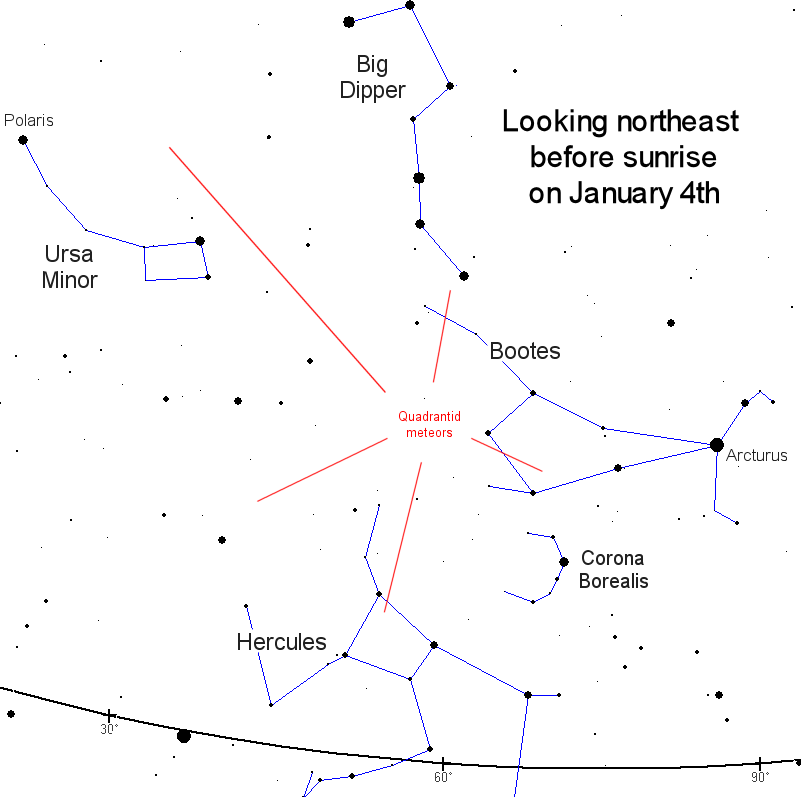
WEEKEND METEOR SHOWER: The annual Quadrantid meteor shower, caused by debris from shattered comet 2003 EH1, peaks on Sunday, January 4th. Because the debris stream is narrow, the shower is expected to be brief, producing a surge of 50 to 100 meteors per hour around 0400 Universal Time. The timing of the peak and the location of the shower's radiant favor observers in northern Europe. No matter where you live, you can listen for Quadrantid echoes from Spaceweather's live meteor radar.
FIRST AURORAS OF 2015: Not long after the clock struck midnight on Dec. 31st, ringing in the New Year, Rayann Elzein saw a luminous green ribbon cutting across the sky above Kaamanen, Finland:

"Perfect way to start the year with the first auroras of 2015!" says Elzein. "A few meteors were also visible, and one was caught on camera."

The combination of meteors and auroras Elzein saw on Jan. 1st could foreshadow the nights of Jan. 3rd and 4th when Earth is expected to pass through (1) a stream of debris from shattered comet 2003 EH1 and (2) a stream of high-speed solar wind flowing from a southern coronal hole on the sun. The double encounter could spark beautiful Northern Lights during the annual Quadrantid meteor shower. NOAA forecasters estimate a 40% chance of polar geomagnetic storms this weekend. . Aurora alerts: text, voice
THE INCREDIBLE TAIL OF COMET LOVEJOY: Warning: Looking at this picture might cause you to buy a telescope. Ready? Here is bright Comet Lovejoy (C/2014 Q2), photographed by amateur astronomer Gerald Rhemann on Dec. 23rd:

To capture the image, Rhemann used a 12-inch remotely controlled telescope in Namibia. Lovejoy's sinuous blue tail was so long (more than 6 degrees of arc) he couldn't fit it into a single field of view. "I had to combine six frames," he says. In fact, it is even too big for this web page. Click on the truncated tail, above, to see the whole thing.

He took the picture more than a week ago. The comet is significantly brighter now. Observers around the world are saying they can see it with the unaided eye from dark sky sites. The comet is shining like a 5th magnitude star, and is expected to double in brightness by mid-January. To the naked eye, it looks like a green fuzzball. Mid-sized backyard telescopes reveal the comet's magnificent blue tail.
Observers should look for the comet passing through the constellation Lepus south of Orion. Consult these finder charts from Sky & Telescope. For accurate pointing of telescopes, an ephemeris from the Minor Planet Center is available.