CHANCE OF FLARES: NOAA forecasters estimate a 50% chance of M-class solar flares today. The likely source would be Earth-facing sunspot AR2253, a large active region with an unstable magnetic field. Solar flare alerts: text, voice
SOLAR WIND SPARKS NORTHERN LIGHTS: Earth is entering a stream of solar wind flowing from a coronal hole in the sun's southern hemisphere. The bulk of the stream is flowing south of our planet, but enough is making contact to spark bright Northern Lights. Rayann Elzein sends this picture from the Finnish Lapland:

"The auroras started at about 3:45pm, just after the sky here became dark enough to see them," says Elzein. "Soon I was watching one of the most amazing, fast and bright displays that I have ever seen. This is a good sign for the evenings ahead with solar wind from the major coronal hole south of the sun reaching our planet!"
The auroras were so bright, even the Full Moon could not wipe them out. "We saw a very nice moon halo arcing through the green curtains--a nice bonus," adds Elzein.

The auroras will probably be back tonight. NOAA forecasters estimate a 50% chance of polar geomagnetic storms as the solar wind continues to blow. Aurora alerts: text, voice
VENUS AND MERCURY: Tonight, when the sun goes down, step outside and face west. Mercury and Venus are converging in the sunset sky. Venus is on top in this picture taken by Giorgia Hofer on Jan. 3rd:
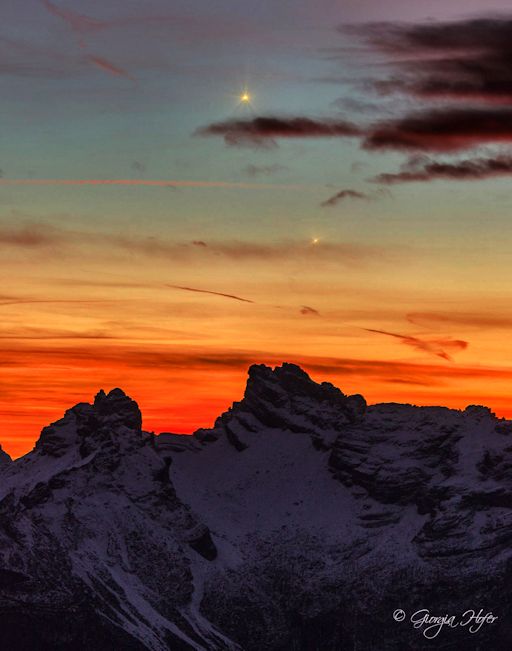
"I was standing on top of Monte Rite (2,300 m) in the Italian Dolomites," says Hofer. "The two planets were an easy target for my Nikon digital camera with a 3 second exposure."
As the week unfolds, the two planets will draw closer and closer together. On the date of closest approach, Jan. 10th, they will be a scant 0.7 degrees apart--a conjunction so tight you can block it out with the tip of your pinky finger held at arm's length.
Venus is the brighter of the two, by a factor of approximately 16. If you can't see Mercury with the naked eye, you might be looking too soon after sunset. Wait a while for the twilight to deepen. Or if you have binoculars, aim them at Venus to reel in Mercury.
Monitor Spaceweather.com's photo gallery for Venus-Mercury snapshots from around the world. Better yet, go outside and see for yourself.
Realtime Space Weather Photo Gallery