UNEXPECTED GEOMAGNETIC STORM: A strong G3-class geomagnetic storm erupted during the early hours of Jan. 7th, sparking bright auroras around Earth's poles. What happened? The interplanetary magnetic field (IMF) near our planet tipped south, opening a crack in Earth's magnetosphere. Solar wind poured in to fuel the strongest magnetic storm since Sept. 2014. NOAA analysts believe the fluctuation in IMF is related to the arrival of a CME originally expected to miss Earth. Browse the aurora gallery for pictures of the event. Aurora alerts: text, voice
BRIGHTENING, GORGEOUS COMET: Comet Lovejoy (C/2014 Q2) continues to brighten, and it can now be seen with the naked eye even from light-polluted urban areas. Science journalist and longtime comet watcher Mariano Ribas reports from the Planetario de Buenos Aires: "Last night, I could see Comet Lovejoy with my unaided eyes in the sky of Buenos Aires. Barely, and only using averted vision. But I saw it!"
"Comparing the comet to nearby background stars, I estimate the comet's visual magnitude to be about 4.2," he continues. "The comet was very bright with my 10x50 binoculars. Also, I could see a hint of its tail. The comet's atmosphere (or 'coma') looks clearly gray/green, and it appears more condensed than one week ago."
What is merely pleasing to the unaided eye transforms into something gorgeous in the focus of a mid-sized telescope. Gerald Rhemann took this picture using a remotely-controlled 12-inch 'scope in Farm Tivoli, Namibia:
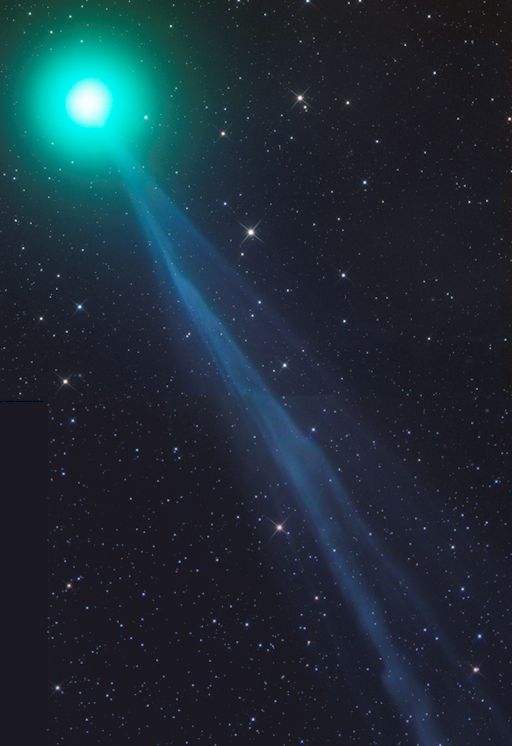
The comet's blue tail is so long, only 1/3rd of it fits in the space provided above. The whole thing stretches more than 7 million km from end to end.

On Jan. 7th, Comet Lovejoy was at its closest to Earth: 0.47 astronomical units (70 million km) away. Although the comet will be moving away from us for the rest of the month, it will continue to grow in brightness because it is still moving closer to the sun.
"Surely," says Ribas, "the best is still to come!"
This week, observers can find Comet Lovejoy passing by the constellation Orion en route to Taurus. For accurate pointing of telescopes, an ephemeris from the Minor Planet Center is available.
RADS ON A PLANE, CONTINUED: Many people think you have to go all the way to the Arctic Circle to experience space weather. Not so. All you have to do is step inside an airplane. Every day more than 8 million people fly somewhere on Earth. All of them are exposed to cosmic rays, a form of high-energy space radiation. To illustrate the point, on Jan. 5th, Dr. Tony Phillips of spaceweather.com carried a pair of ionizing radiation detectors onboard a US Airways flight from Reno to Phoenix. At cruising altitude (38,700 ft) he measured dose rates 42 times higher than at ground level:


At this rate, a passenger flying for 5 hours could be exposed to about as much radiation as a dental X-ray--not dangerous, but not negligible either.
The radiation comes from space. Cosmic rays are subatomic particles accelerated to nearly light speed by supernovas, active galactic nuclei, and solar flares. Earth is peppered with this kind of radiation, every day, from all directions. Cosmic rays penetrate our planet's atmosphere, producing a spray of secondary particles that air travelers routinely (and mostly unknowingly) absorb as they fly.
Cosmic rays are a genuine form of space weather. They fluctuate in response to solar storms--both up and down. For example, solar flares can accelerate energetic particles toward Earth, adding to the flux of cosmic rays. CMEs, on the other hand, sweep aside cosmic rays, causing radiation counts to dip. When you step on a plane, you're never quite sure what you're going to get.
Case in point: Phillips took the same flight from Reno to Phoenix on Nov. 11, 2014. He measured 40% more radiation then vs. now. The difference is not fully understood.

Here are the data from the Jan. 5th flight:
The two curves, orange and blue, trace data from two identical yet independent radiation detectors. Differences between the two curves are an indication of the measurement uncertainty. Using helium balloons, spaceweather.com and the students of Earth to Sky Calculus have flown these detectors to the stratosphere dozens of times to monitor the response of Earth's upper atmosphere to solar storms. They are sensitive to ionizing radiation such as X-rays and gamma-rays in the energy range 10 keV to 20 MeV.
It is important to note that these sensors sample only a fraction of the total radiation. In particular, they are not sensitive to neutrons, a key form of biologically effective radiation at aviation altitudes. Adding neutrons to the count could more than double the measured dose. Solar flare alerts: text, voice
Realtime Space Weather Photo Gallery