CHANCE OF FLARES: Solar activity is low, but the quiet could be short-lived. During the past 24 hours, sunspots AR2255 and AR2257 have developed 'beta-gamma-delta' magnetic fields that harbor energy for powerful explosions. NOAA forecasters estimate a 40% chance of M-class solar flares and a 10% chance of X-flares on Jan. 12th. Solar flare alerts: text, voice
HOO, ARE THOSE PLANETS? A beautiful conjunction is underway in the sunset sky. The first two planets from the sun, Mercury and Venus, have converged until they are separated by little more than 1o of arc. Such a tight conjunction is eye-catching--even to wildlife. Last night in Chile, photographer Yuri Beletsky observed the display alongside a young owl:

"I was planning to take some images of the planets this evening, when I suddenly spotted a small owl sitting on top of a nearby rock," says Beletsky. "It seems the night bird was really curious about the celestial event :) Venus is the brightest object in the image, on top, with fainter Mercury just below."
The planets were at their closest (0.7o) on Jan. 10th. They are separating now, albeit so slowly that the view will remain pleasing for the rest of the week. Take a look. It's a nice way to end the day.
THE "OTHER" MILKY WAY: On Jan. 11th, Michael Jäger of Weißenkirchen, Austria, photographed a milky band meandering through the constellation Taurus. It was not, however, the Milky Way. Click on the image to discover its identity:
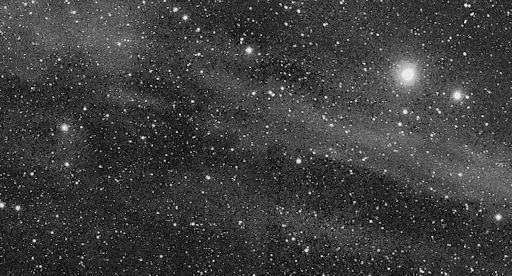
It is the tail of Comet Lovejoy (C/2014 Q2), which now stretches more than 8o across the sky. For comparison, that is 16 times the width of a full Moon. The actual Milky Way is made of stars. The tail of Comet Lovejoy is made of ionized gas, and it is considerably more dynamic. Earlier this month, a magnetic storm in the comet's tail caused a "disconnection event" and a blob of plasma to propagate down the long gaseous structure.
Lovejoy's milky tail is faint. Considerable skill is required to photograph its delicate streamers and meandering blobs. However, almost anyone can see the comet's head, which is now glowing like a 4th magnitude star in the constellation Taurus (finder charts). It is visible to the unaided eye from dark-sky country sites and an easy target for backyard telescopes even in light-polluted urban areas. For accurate pointing of optics, an ephemeris from the Minor Planet Center is available.
THAI PEPPERS GET 'SPACE RADIATION TREATMENT': On Jan. 10th, Spaceweather.com and the students of Earth to Sky Calculus launched another Space Weather Buoy to the stratosphere, marking the 67th flight of their Space Weather Ballooning program. At the moment, cosmic ray fluxes are slowly rebounding from a sudden drop in late December 2014. The purpose of the flight is to investigate how the "radiation rebound" percolates through Earth's atmosphere.
In addition to the usual radiation sensors, this Buoy carried something extra: Thai pepper seeds. The students want to know if peppers exposed to high-altitude radiation are "hotter" than a control sample on the ground. To find out, they sent hundreds of the seeds to the stratosphere:


The payload has since traveled more than 111,000 feet high and parachuted back to Earth in the Death Valley National Park. En route, the seeds were exposed to radiation levels more than 40 times Earth-normal--a dose of cosmic rays similar to what you would get on the surface of Mars. The payload also contained seeds for Beefsteak Tomatoes and colorful "Solar Flare" Zinnias.
Update: On Jan. 11th, a recovery team hiked into the desert and brought back the payload. The seed samples returned intact, as did all of the camera and sensors. Dr. Tony Phillips and the students are reducing the data now. Stay tuned!
Realtime Space Weather Photo Gallery