CHANCE OF STORMS: NOAA forecasters estimate a 40% chance of polar geomagnetic storms on Jan. 15th when a CME is expected to sideswipe Earth's magnetic field. The storm cloud was propelled in our direction by a solar filament eruption two days ago. Residents of the Arctic, be alert for auroras. Solar flare alerts: text, voice
SPACE WEATHER BUOYS INVESTIGATE COSMIC RAYS: Did you know...? The flux of cosmic rays around Earth has been increasing for the past week. To investigate, spaceweather.com and the students of Earth to Sky Calculus are launching a series of Space Weather Buoys to the stratosphere. Carred aloft by helium balloons, each Buoy carrries a pair of radiation sensors, a GPS altimeter, and multiple cameras to record the flight. Here is the view from 111,100 feet captured by a Buoy launched on Jan. 10th:

In the lower right of this picture, visible through a wide gap in the clouds, is Bishop, CA, the small mountain town where most of the student researchers live. Spaceweather.com HQ is located in the Sierras overlooking Bishop, underneath a bank of white, fluffy clouds.

Another launch is scheduled for today, Jan. 14th. By the end of the week we hope to share data showing how atmospheric radiation levels are responding to the ongoing uptick in cosmic rays.
Hey thanks! The Jan. 10th flight was made possible by a generous donation of $500 from spaceweather.com reader Jack Jewell. A picture of Jack crossing the finish line of a 50-mile ultramarathon flew to the stratosphere on top of the Bouy. Here it is in flight:

Readers, if you would like to follow in Jack's footsteps to the stratosphere by sponsoring a flight, please contact Dr. Tony Phillips to make arrangements.
Realtime Space Weather Photo Gallery
THE "OTHER" MILKY WAY: On Jan. 11th, Michael Jäger of Weißenkirchen, Austria, photographed a milky band meandering through the constellation Taurus. It was not, however, the Milky Way. Click on the image to discover its identity:
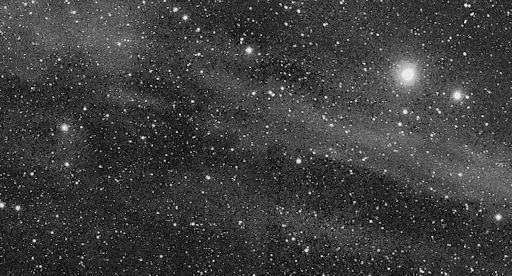
It is the tail of Comet Lovejoy (C/2014 Q2), which now stretches more than 10o across the sky. For comparison, that is 20 times the width of a full Moon. The actual Milky Way is made of stars. The tail of Comet Lovejoy is made of ionized gas, and it is considerably more dynamic. Earlier this month, a magnetic storm in the comet's tail caused a "disconnection event" and a blob of plasma to propagate down the long gaseous structure.
Comet Lovejoy's tail is faint. Considerable skill is required to photograph its delicate streamers and meandering blobs. However, almost anyone can see the comet's head, which is now glowing like a 4th magnitude star in the constellation Taurus. It is visible to the unaided eye from dark-sky sites far from cities, and it is an easy target for backyard telescopes even in light-polluted urban areas. Check Sky & Telescope for finder charts. Also, the Minor Planet Center has published an ephemeris for accurate pointing of telescopes.
SUNSET PLANETS: Hold your index finger at arm's length. Observe the width of the fingertip. That's the distance between Venus and Mercury in the sunset sky. The two planets have converged to form a tight pair visible from towns and cities around the world. Paolo Bardelli sends this picture, taken Jan. 12th, from Schiranna (Varese), Italy:
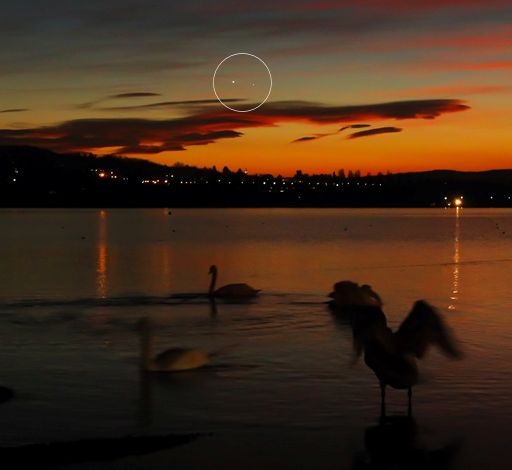
To observe the conjunction, look west at the end of the day. Venus pops out of the twilight first, followed by Mercury. If you can't see Mercury, wait a while for the sky to darken, or scan the area around Venus using binoculars to reel in the fainter planet. The two worlds will appear close together for the next week. A date of special interest is Jan. 21st when the crescent Moon will join Mercury and Venus to form a sunset triangle about 5o wide. Stay tuned for that.