GEOMAGNETIC UNREST: A coronal hole surrounding the sun's south pole is spewing solar wind toward Earth. This could cause geomagnetic unrest and auroras around the Arctic Circle on Feb. 1-3: photos. Aurora alerts: text, voice
CLOUDTOP GREEN FLASH: Spaceweather.com reader Mila Zinkova of San Francisco was photographing the sunset on Jan. 29th when a puff of sun detached itself and turned green. It was a rare cloud-top green flash:
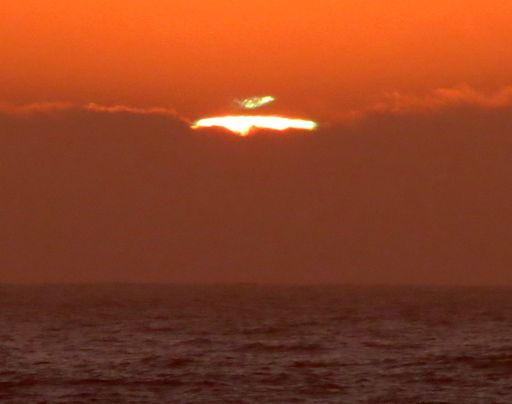
Atmospheric optics expert Les Cowley explains what happened: "San Francisco and the Californian coast is a world top spot for green flashes. Air is cooled by the cold offshore current and topped by warmer air from inland to provide the ideal temperature profile for sunset mirages and flashes."
"Mila's flash might be something extra special - a 'cloud-top' flash. These are seen as the sun's rays graze a distant cloud bank. Marine stratus can be trapped by temperature inversion layers which could generate some of the flashes. But that is not always the case; there is much unexplained about them."
Realtime Space Weather Photo Gallery
RED AIRGLOW: The OGLE telescope in Las Campanas, Chile, is hunting for signs of Dark Matter in the Milky Way using a technique called "microlensing." This week, to highlight OGLE's mission, astrophotographer Yuri Beletsky lined up his camera behind the observatory dome with the Milky Way in the background. He captured not only the center of the galaxy, but also a fine display of red airglow:

"The Milky Way emerged from the top of the dome like a stellar fountain," says Beletsky. "Red airglow is quite prominent in the background."
Airglow is aurora-like phenomenon in the upper atmosphere caused by chemical reactions driven mainly by solar ultraviolet radiation. Human eyes seldom notice the faint glow, but It can be photographed on almost any clear dark night, anywhere in the world.
The curious thing about Beletsky's photo is not the presence of airglow, but rather its color--red. Airglow is usually green, the color of light from abundant oxygen atoms in a layer 90-100 km high. Red airglow comes from oxygen, too, but in a more rarefied layer of air 150 - 300 km high. Why did red dominate green on the night of Beletsky's photo shoot? The wavy structure of the red glow offers a clue: High-altitude gravity waves might have altered the temperature and density of the upper atmosphere just enough to favor red. Consider it a beautiful mystery.
UPDATE: Steve Smith of the Center for Space Physics at Boston University thinks the red color might be caused by OH instead of O. "Yuri Beletsky took a wonderful photo of the Milky Way and airglow," he says. "I don't think that the red airglow is due to O(1D) emission from 250 km. I think its probably due to OH from near 85 km. The Meinel bands extend from ~600nm into the IR and although the visible bands are fainter those in the IR, they are still reasonably bright. Also, the wave structures are also well-defined - that is unusual (but not impossible) in O(1D) emission."