CHANCE OF MAGNETIC STORMS: For the third day in a row, a high-speed stream of solar wind is buffeting Earth's magnetic field. Observers around the Arctic Circle have been seeing bright auroras, and the display could continue tonight. NOAA forecasters estimate a 35% chance of polar geomagnetic storms on Feb. 4th. Aurora alerts: text, voice
TRUE COLORS OF THE MOON: What color is the Moon? If you had to pick a single hue, it would probably be gray. There are light-gray lunar highlands, dark-gray lunar seas, and miles and miles of gray moondust everywhere. Yet the Moon is not monochromatic. Astronomers have long known that the Moon's terrain is actually rich in subtle color. Consider this image of the "Snow Moon" taken last night by Maximilian Teodorescu of Comana Woods, Romania:

Teodorescu boosted the natural colors of the Moon using Photoshop. "This is how the Moon would look like if we could have an saturation-enhancement filter integrated in our eyes," he says.
The colors reveal the Moon's mineral composition. Blue denotes areas rich in titanium, while orange is titanium poor. Pink traces iron-poor, aluminum-rich feldspars found in the lunar highlands. A challenge to astrophotographers: Capture the colors of tonight's Moon. It's not as gray as you think.
Realtime Space Weather Photo Gallery
SPACE ROSES FOR VALENTINE'S DAY: Valentine's Day is just around the corner, and many people are preparing to give the gift of roses. But wait. How about space roses, instead? On Jan. 28th, Spaceweather.com and the students of Earth to Sky Calculus flew a batch of rose seeds to the stratosphere. They went aloft inside a standard Space Weather Buoy, nestled alongside cameras, radiation sensors and GPS trackers. Here is a picture of the seeds 107,300 above Earth's surface:
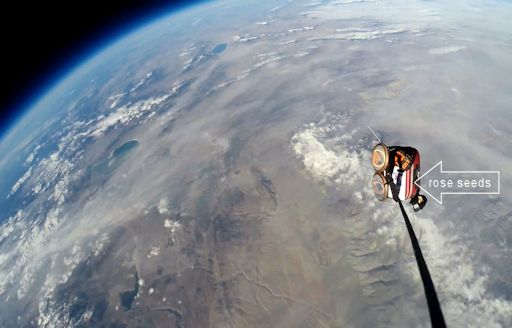
En route to the edge of space, the seeds experienced cosmic radiation levels, temperatures, and pressures akin to those on the planet Mars. What kind of roses will these "space seeds" produce? We only know this: A seed packet of space roses would make a unique Valentine's gift.
Get yours now. For only $49.95 we will mail you a packet of seeds along with a Valentine's card authenticating their flight. 100% of funds received will be used for student research. For more information, contact Dr. Tony Phillips.
Realtime Space Weather Photo Gallery
SOLAR FILAMENT: Most solar flares come from sunspots. The next big explosion, however, could come from a different source: A huge filament of magnetism is rotating over the sun's southeastern limb, shown here in a Feb. 4th image from NASA's Solar Dynamics Observatory:

This structure is, essentially, a tendril of plasma more than 350,000 km long held suspended above the surface of the sun by magnetic forces. If it becomes unstable and erupts, it could hurl parts of itself into space. Pieces of the filament falling back to the solar surface would explode upon impact, creating one or more Hyder flares.
Astronomers with backyard solar telescopes are encouraged to monitor the structure as it turns toward Earth. A photogenic explosion may be in the offing. Solar flare alerts: text, voice