QUIET WITH A CHANCE OF FLARES: Solar activity is low. However, sunspot AR2277 has an unstable 'beta-gamma' magnetic field that could erupt. NOAA forecasters estimate a 20% chance of M-class solar flares on Feb. 5th. Solar flare alerts: text, voice
CLOSE ENCOUNTER WITH JUPITER: This week, Jupiter is at its biggest, brightest, and closest to Earth for all of 2015. For reasons this diagram makes clear, astronomers call this "the opposition of Jupiter." The giant planet rises in the east at sunset and soars overhead at midnight, outshining everything except the Moon and Venus. Giorgia Hofer sends this picture from Laggio di Cadore, Veneto, Italy:

"I caught Jupiter and its satellites setting behind the Marmarole on the morning of February 4th at 6:50 am," says Hofer. "It was very bright."
Oppositions of Jupiter happen every 13 months, but this one is special. In a rare coincidence, Jupiter's opposition on Feb. 6th coincides almost perfectly with its equinox on Feb. 5th when the Sun crosses Jupiter's equatorial plane. It is an edge-on apparition of the giant planet that sets the stage for a remarkable series of events. For the next couple of months, backyard sky watchers can see the moons of Jupiter executing a complex series of mutual eclipses and transits.
For instance, on Feb. 5th, volcanic Io will cast its shadow on Ganymede, Jupiter's largest moon.. Two days later, on Feb. 7th, icy Europa will cast its shadow on Io. Events like these will continue, off and on, until July 2015.
Look up at midnight for the brightest light from the outer solar system you'll see all year.
Realtime Space Weather Photo Gallery
SPACE ROSES FOR VALENTINE'S DAY: Valentine's Day is just around the corner, and many people are preparing to give the gift of roses. But wait. How about space roses, instead? On Jan. 28th, Spaceweather.com and the students of Earth to Sky Calculus flew a batch of rose seeds to the stratosphere. They went aloft inside a standard Space Weather Buoy, nestled alongside cameras, radiation sensors and GPS trackers. Here is a picture of the seeds 107,300 above Earth's surface:
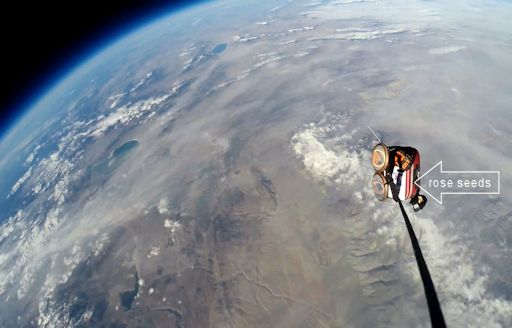
En route to the edge of space, the seeds experienced cosmic radiation levels, temperatures, and pressures akin to those on the planet Mars. What kind of roses will these "space seeds" produce? We only know this: A seed packet of space roses would make a unique Valentine's gift.
Get yours now. For only $49.95 we will mail you a packet of seeds along with a Valentine's card authenticating their flight. 100% of funds received will be used for student research. For more information, contact Dr. Tony Phillips.
Realtime Space Weather Photo Gallery
SOLAR FILAMENT: Most solar flares come from sunspots. The next big explosion, however, could come from a different source: A huge filament of magnetism is snaking over the sun's southeastern limb, shown here in a Feb. 5th image from NASA's Solar Dynamics Observatory:

This structure is, essentially, a tendril of plasma more than 400,000 km long held suspended above the surface of the sun by magnetic forces. If it becomes unstable and erupts, it could hurl parts of itself into space. Pieces of the filament falling back to the solar surface would explode upon impact, creating one or more Hyder flares.
Astronomers with backyard solar telescopes are encouraged to monitor the structure as it turns toward Earth. A photogenic explosion may be in the offing. Solar flare alerts: text, voice