DSCOVR LAUNCH UPDATE: Sunday's launch of the Deep Space Climate Observatory ("DSCOVR" for short) was scrubbed due to the failure of an Air Force radar. The next launch window opens on Tuesday, Feb. 10 at 6:05 pm EST with a backup launch opportunity on Wednesday, Feb. 11 at 6:03 pm. DSCOVR will monitor solar wind from the L1 point one-million miles upstream from Earth and succeed the aging ACE spacecraft in providing early warnings of incoming CMEs and other solar storms. It is a very important space weather mission. Monitor the launch blog for updates.
WHAT'S INSIDE THE GIANT MAGNETIC SLINKY?: A giant, slinky-shaped column of magnetism has formed on the sun, shown below in an extreme UV image from NASA's Solar Dynamics Observatory. What's inside the curly column? Click on the image to find out:

It's a dark solar filament--essentially, a tendril of plasma more than 1,000,000 km long held suspended above the surface of the sun by magnetic forces. If the filament becomes unstable and erupts, it could hurl parts of itself into space. Pieces of the filament falling back to the solar surface would explode upon impact, creating one or more Hyder flares.
Astronomers with backyard solar telescopes are encouraged to monitor the structure as it turns toward Earth. A photogenic explosion may be in the offing. Solar flare alerts: text, voice
SOLAR WIND SPARKS SOUTHERN LIGHTS: Earth is passing through a high-speed stream of solar wind, and its gentle buffeting is sparking auroras around the poles. Over the weekend in New Zealand, sky watchers saw a rare summer apparition of aurora australis:
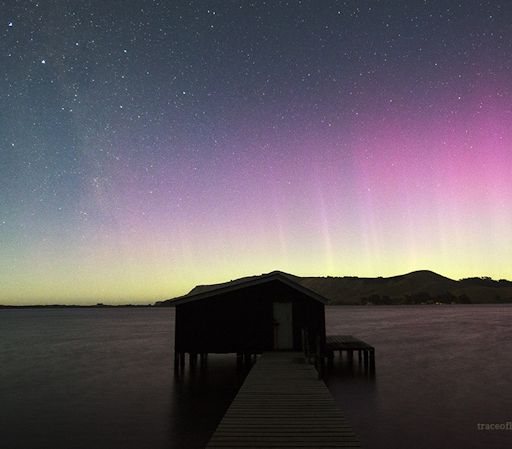
"Despite a bright horizon and twilight glow, the auroras sparkled over Otago Peninsula," says photographer Taichi Nakamura of Dunedin, New Zealand. "This is a beautiful spot where I love to chill out, day or night."
High-latitude sky watchers should remain alert for auroras. NOAA forecasters estimate a 30% chance of minor geomagnetic storms on Feb. 9th as the solar wind continues to blow. Aurora alerts: text, voice
SPACE ROSES FOR VALENTINE'S DAY: Valentine's Day is just around the corner, and many people are preparing to give the gift of roses. But wait. How about space roses, instead? On Jan. 28th, Spaceweather.com and the students of Earth to Sky Calculus flew a batch of rose seeds to the stratosphere. They went aloft inside a standard Space Weather Buoy, nestled alongside cameras, radiation sensors and GPS trackers. Here is a picture of the seeds 107,300 feet above Earth's surface:
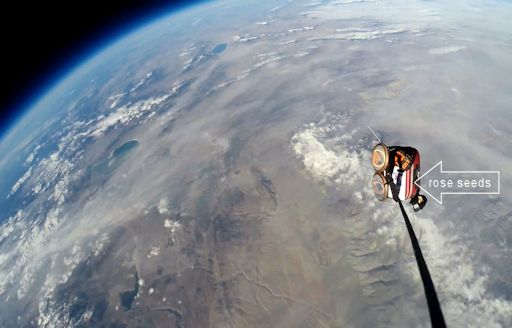
En route to the edge of space, the seeds experienced cosmic radiation levels, temperatures, and pressures akin to those on the planet Mars. What kind of roses will these "space seeds" produce? We only know this: A seed packet of space roses would make a unique Valentine's gift.
Get yours now. For only $49.95 we will mail you a packet of seeds along with a Valentine's card authenticating their flight. 100% of funds received will be used for student research. For more information, contact Dr. Tony Phillips