DSCOVR LAUNCH TODAY: NOAA, NASA and the US Air Force are about to launch an important space weather satellite: the Deep Space Climate Observatory, a.k.a. "DSCOVR". The launch window opens on Tuesday, Feb. 10 at 6:05 pm EST with a backup launch opportunity on Wednesday, Feb. 11 at 6:03 pm. DSCOVR will monitor solar wind from the L1 point one-million miles upstream from Earth and succeed the aging ACE spacecraft in providing early warnings of incoming CMEs and other solar storms. Check the launch blog for updates.
ACTIVE SUNSPOT: The magnetic field of sunspot AR2282 does not appear to be unstable ... yet it is. Proof came on Feb. 9th at 23:35 UT when the sunspot's magnetic canopy unexpectedly erupted, producing an M2-class solar flare. NASA's Solar Dynamics Observatory recorded the blast:

The explosion produced a coronal mass ejection (CME). Radio emissions produced by shock waves at the leading edge of the CME suggest an expansion velocity of more than 1000 km/s (2.2 million mph). The storm cloud is not on a sun-Earth line, and will probably miss our planet, but this requires confirmation from analysis of incoming coronagraph data. Stay tuned. Solar flare alerts: text, voice
Realtime Space Weather Photo Gallery
ZODIACAL LIGHT: Around the world, people far from city lights are noticing a luminous triangle rising out of the western sky at sunset. It is the Zodiacal Light. Last night, Feb. 9th, Alan Dyer photographed the phenomenon from the City of Rocks State Park in New Mexico:
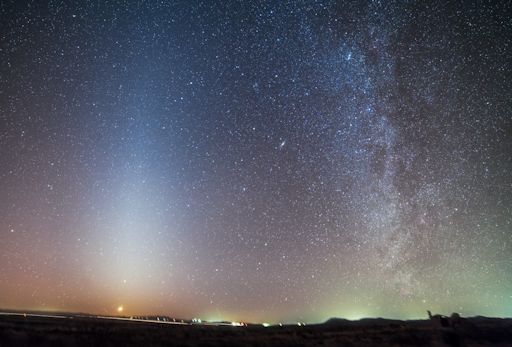
Dyer, author of "How to Shoot and Process Nightscapes," describes the photo: "The tower of light at left is the Zodiacal Light. At right is the setting autumn Milky Way. At the base of the Zodiacal Light is bright Venus just setting, with fainter Mars above it."
Zodiacal light is sunlight reflected from billions of dust particles littering the solar system's orbital plane. These are the same dust particles that make meteors when they occasionally hit Earth's atmosphere. Zodiacal Light is very faint, so dark skies are required to see it. Now is a good time to look because the Moon is absent from the evening sky. A trip to the countryside on a moonless February evening often results in a Zodiacal Light sighting. Try it!
Realtime Zodiacal Light Photo Gallery
SPACE ROSES FOR VALENTINE'S DAY: Valentine's Day is just around the corner, and many people are preparing to give the gift of roses. But wait. How about space roses, instead? On Jan. 28th, Spaceweather.com and the students of Earth to Sky Calculus flew a batch of rose seeds to the stratosphere. They went aloft inside a standard Space Weather Buoy, nestled alongside cameras, radiation sensors and GPS trackers. Here is a picture of the seeds 107,300 feet above Earth's surface:
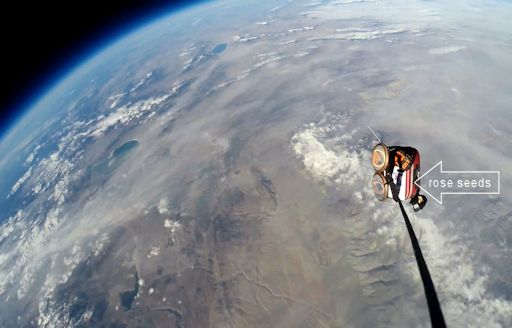
En route to the edge of space, the seeds experienced cosmic radiation levels, temperatures, and pressures akin to those on the planet Mars. What kind of roses will these "space seeds" produce? We only know this: A seed packet of space roses would make a unique Valentine's gift.
Get yours now. For only $49.95 we will mail you a packet of seeds along with a Valentine's card authenticating their flight. 100% of funds received will be used for student research. For more information, contact Dr. Tony Phillips