SPACE WEATHER LAUNCH TODAY: In Florida, the weather forecast is 90% "go" for today's launch of the Deep Space Climate Observatory (DSCOVR) from Cape Canaveral. Liftoff is scheduled for Wednesday, Feb. 11, at 6:03 pm. DSCOVR is a satellite of considerable importance to space weather forecasting. Once launched, it will monitor solar wind from the L1 point one-million miles upstream from Earth and succeed the aging ACE spacecraft in providing early warnings of incoming CMEs and other solar storms. Check the launch blog for updates.
SUPER SOLAR FILAMENT: It is, arguably, the second biggest thing in the solar system. A filament of magnetism almost 1,000,000 km long is stretching across the face of the sun. Only the sun itself is bigger. Yesterday in the Canary Islands, Frank A. Rodriguez used a Lunt Solar Telescope to photograph the super structure:
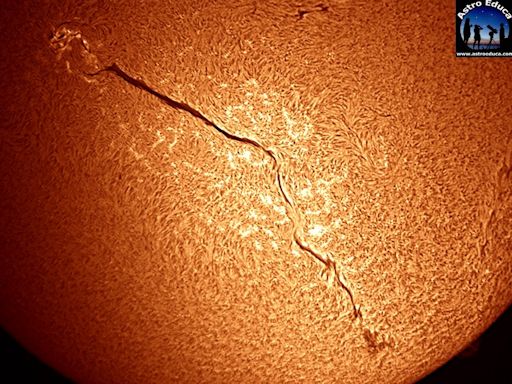
This is a solar filament, a tendril of plasma held suspended above the surface of the sun by magnetic forces. Filaments appear on the sun all the time, but this one is unusually large, 5 to 10 times longer than ordinary filaments. If it becomes unstable and erupts, it could hurl parts of itself into space. Pieces of the filament falling back to the solar surface would explode upon impact, sparking a Hyder flare.
Astronomers with backyard solar telescopes are encouraged to monitor the structure in the days ahead. A photogenic explosion may be in the offing.Solar flare alerts: text, voice
Realtime Space Weather Photo Gallery
DON'T FORGET COMET LOVEJOY: Comet Lovejoy (C/2014 Q2) is receding from Earth and fading. But good news: It is not fading as quickly as forecasters expected. "In fact," says Jan Curtis of Santa Fe, New Mexico, "if you know where to look you can still see it with the unaided eye." Curtis created this composite image showing Lovejoy on 5 consective nights under "near-perfect" New Mexico skies:
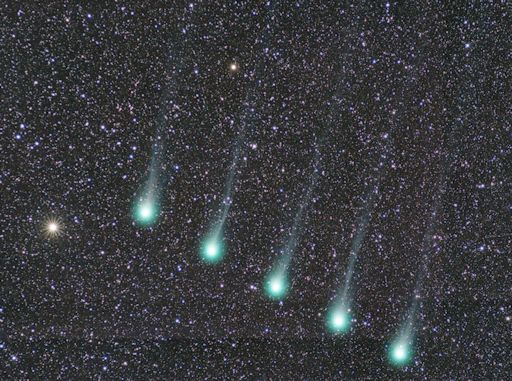
The comet's brightness is currently near 5th magnitude--barely above the threshold for human visibility. "Its close transit past 2nd magnitude star Almach in Andromeda helped me find it," says Curtis. "In binoculars, Lovejoy's tail was visible but considerably shorter than these 20 minute daily exposures reveal. "
The current spate of moonless nights sets the stage for good photography of this relatively bright comet. Lovejoy is currently passing through the constellation Andromeda, high in the northern sky after sunset. Finder charts from Sky & Telescope will help you find it. For pinpoint guidance of telescopes, use this ephemeris from the Minor Planet Center.