QUIET WEEKEND: Solar activity remains low. With no sunspots actively flaring, the sun's X-ray output has flatlined. NOAA forecasters estimate a scant 1% chance of X-flares and a 20% chance of M-flares on Feb. 14th. Solar flare alerts: text, voice

HAPPY VALENTINE'S DAY: It's February 14th, and even the skies seem to know it is Valentine's Day. Dr Peter Lowenstein photographed "a lonely cloud pouring its heart out" over Mutare, Zimbabwe:

"It is not often that one sees heart-shaped clouds and rarer still to see rain falling in such a narrow well defined stream from underneath one," says Lowenstein.
More lovely images of the sky may be found in the realtime photo gallery. Happy Valentine's Day!
Realtime Space Weather Photo Gallery
JUPITER'S MOONS: In January of 1610, when Galileo Galilei discovered the moons of Jupiter, they were just pinpricks of light in his primitive spyglass. Fast forward 400 years. On Feb. 12th, Pete Lawrence of Selsey, England, looked through a modern backyard telescope and saw Jupiter's moons, not as dimensionless pinpricks, but rather as well-defined worlds casting their shadows upon one another:

"A lucky break in the clouds gave me a good view of Io and Ganymede," says Lawrence. "Jupiter is now just past equinox, which means that we are currently seeing the orbits of the four Galilean moons virtually edge on. This alignment allowed me to record the shadow of Io clipping the disc of Ganymede."
For reference, Io is festooned with the most active volcanoes in the solar system and, with a diameter of 3,636 km, measures slightly wider than Earth's Moon (3475 km). Heavily-cratered Ganymede (5,268 km) is bigger than Mercury (4,879 km), which means Jupiter has a moon larger than a whole planet. No wonder their disks are visible from Earth.
"All of the images were taken using my Celestron 14-inch telescope," Lawrence says. Imagine what Galileo could have discovered with that.
Realtime Jupiter Photo Gallery
DEEP SPACE CLIMATE OBSERVATORY: For years, space weather forecasters have worried about the aging ACE spacecraft, which provides early warnings of CMEs and other solar storms bearing down on Earth. Launched in 1997, ACE could fail at any moment, leaving us blind to incoming storms. On Feb. 11th, NOAA, NASA and the US Air Force launched a replacement--the Deep Space Climate Observatory (DSCOVR).
DSCOVR blasted off from Cape Canaveral on Wednesday at 6:03 p.m. EST atop a SpaceX Falcon 9 rocket. Shortly after liftoff, an American Airlines flight en route from JFK to San Juan flew past the area. Passenger Tim Leavitt pointed his iPhone out the window and captured some remarkable shots of the rocket's exhaust:
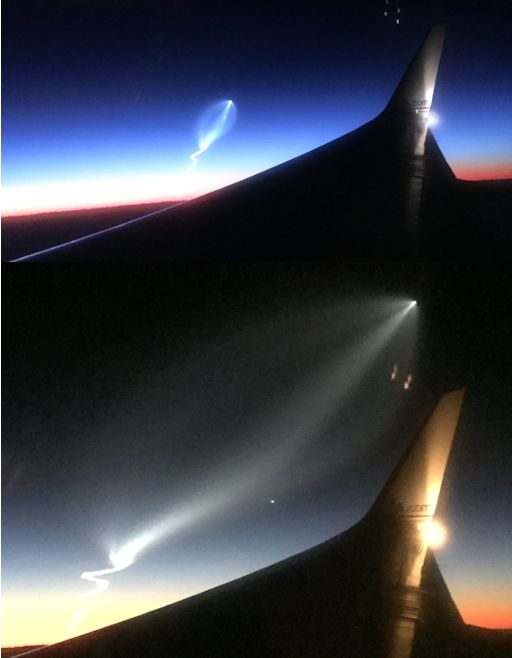
"What an amazing vantage point--and a lucky shot," says Leavitt.
The spacecraft is now on its way to the L1 point where it will monitor the solar wind one million miles upstream from Earth. NOAA says DSCOVR is in good health. Its solar arrays have deployed and it is communicating with the ground. Approximately 150 days after launch, DSCOVR will replace ACE as our primary warning system for solar magnetic storms.
In addition to monitoring the solar wind, DSCOVR will also look back at Earth. The spacecraft's EPIC camera has ten filters for photographing our planet at wavelengths ranging from UV to visible light. True-color images of the full sun-facing side of Earth will be publicly available approximately 24 hours after they are taken. The first images will be posted approximately six months after launch. EPIC's observations will be used to measure ozone and aerosols, cloud height, vegetation properties and the ultraviolet reflectivity of Earth. Another instrument onboard, called NISTAR, measures solar energy reflected from the sunlit face of Earth. This will help climate scientists track changes in Earth's radiation budget caused by human activities and natural phenomena.
Got pictures of the launch? Submit them here.