QUIET SUN: Solar activity remains very low. The sun is peppered with seven sunspot groups, but most of them are small, and none of them is producing strong flares. NOAA forecasters put the odds of an M-class solar flare on Feb. 19th at no more than 1%. Solar flare alerts: text, voice
RED AURORAS OVER MONTANA: Earth is exiting a solar wind stream that sparked bright auroras around the Arctic Circle on Feb. 17th and 18th. At its peak, the display was visible in several northern-tier US states. Philip Granrud sends this picture from the Polebridge Mercantile in northwest Montana:
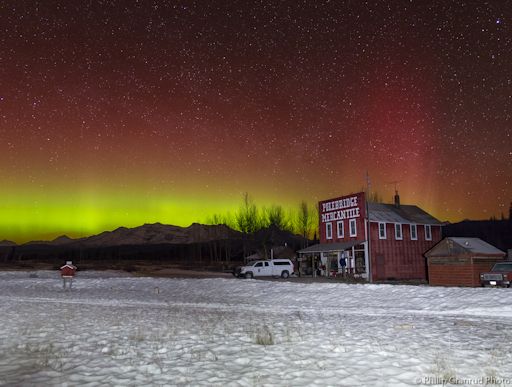
"The Northern Lights were low to the horizon, but very bright," says Granrud. "It was a clear cold night, which helped with visibility."
Much of the sky was filled with red, a hue typical of auroras seen from a distance. Red auroras occur some 300 to 500 km above Earth's surface, much higher than ordinary green auroras. Because of their high altitude, reds can be seen over the horizon. In this case, the main display was probably taking place in Canada, far to the north of the Polebridge Mercantile.
Red auroras are not fully understood. Some researchers believe the red lights are linked to low energy electrons from the sun, which move too slowly to penetrate deeply into the atmosphere. When such electrons recombine with oxygen ions in the upper atmosphere, red photons are emitted. At present, space weather forecasters cannot predict when this will occur. Aurora alerts: text, voice
VENUS AND MARS: When the sun goes down tonight, step outside and face west. Venus is beaming through the twilight, so bright that it is often mistaken for a landing plane. Wait a while as the sky grows darker. Fainter Mars pops out right beside Venus. Didier Van Hellemont photographed the pair at sunset on Feb. 17th over Sint-Laureins, Belgium:
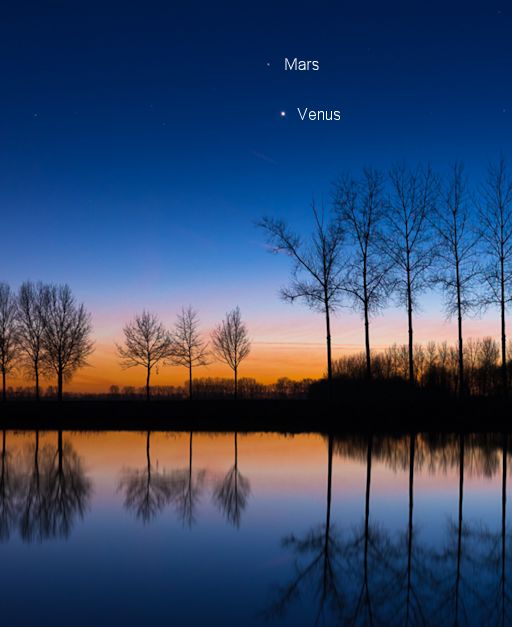
In only a few days, the two planets will be dramatically closer together. At closest approach on Feb. 21st, they will be only 0.4o apart, less than the width of a full Moon. The night before closest approach might be best of all: On Feb. 20th, the crescent Moon will pass right by the converging planets. Mark both dates on your calendar, Feb. 20th and 21st, and watch the western sky at sunset. It's a great way to end the day.
Realtime Space Weather Photo Gallery