CHANCE OF MAGNETIC STORMS: NOAA forecasters estimate a 40% chance of geomagnetic storms on Feb. 22-23 in response to an incoming solar wind stream. Polar sky watchers should be alert for auroras. Aurora alerts: text, voice
SUNSET SKY ALERT: When the sun goes down tonight, step outside and face west. You might see something like this:
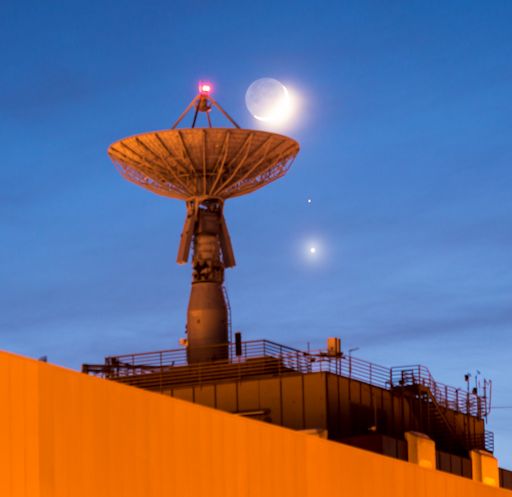
Jason Ahrns took the picture last night, Feb. 20th, from the Geophysical Institute in Fairbanks, Alaska. "I walked outside on my way home and noticed this beautiful twilight conjunction," says Ahrns. "I thought it would be great to get it alongside the satellite dish on the Institute's roof."
On Friday evening when he took the picture, the crescent Moon had just passed by Venus and Mars, which are having a close encounter in the sunset sky. Tonight, the two planets are even closer together, only 0.4o apart. Brilliant Venus pops into view as soon as the sun goes down. Fainter Mars takes longer to make itself known. As the sky fades to black you will see them both--well worth the wait! More photos of the conjunction may be found in the realtime photo gallery.
Realtime Space Weather Photo Gallery
UNUSUAL COMET DIVE-BOMBS THE SUN: Astronomers are puzzling over a comet that passed "insanely close" to the sun on Feb. 19th. At first glance it appeared to be a small object, not much bigger than a comet-boulder, doomed to disintegrate in the fierce heat. Instead, it has emerged apparently intact and is actually brightening as it recedes from the sun. Click to view a post-flyby movie recorded on Feb. 20th by the Solar and Heliospheric Observatory (SOHO):

Unofficially, the icy visitor is being called "SOHO-2875," because it is SOHO's 2,875th comet discovery.
Karl Battams of the Naval Research Lab explains what's odd about SOHO-2875: "It's a 'non-group comet,' meaning that it does not appear to be related to any other comet or comet family that we have on record."
Most comets that SOHO sees belong to the Kreutz family. Kreutz sungrazers are fragments from the breakup of a single giant comet many centuries ago. They get their name from 19th century German astronomer Heinrich Kreutz, who studied them in detail. SOHO-2875, however, is not one of those fragments.
"Non-group comets like this appear a few times a year, so in that sense it's not too unusual," continues Battams. "But this one is relatively bright. The big question most people will have now is, Can I see it, or will I be able to see it, from Earth? At first I thought the answer was no. But I am very pleasantly surprised--shocked in fact! The comet has brightened dramatically and now is sporting an increasingly impressive tail. Visibility from Earth in a few weeks is no longer out of the question, although I still wouldn't put money on it."
"I'll continue to tweet updates on my twitter.com/SungrazerComets feed, so folks can follow along there too."
EUROPA ECLIPSES IO: This month, Jupiter is edge-on to the sun. As a result of the alignment, Jupiter's moons are casting their shadows on Jupiter and on one another. On Feb. 18th, astrophotographer Christopher Go of the Philippines caught Europa's shadow passing across Io:
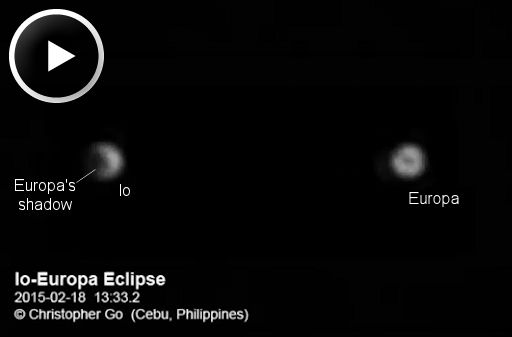
"About 30 minutes earlier I caught Europa itself passing across Io," says Go. See the movie.
Events like these will continue, off and on, until July 2015. Browse the realtime Jupiter photo gallery for more examples.