QUIET SUN: Solar activity is very low. No sunspots are actively flaring, and the sun's X-ray output is flatlining again. NOAA forecasters estimate a 1% chance of M-class flares on Feb. 23rd. Solar flare alerts: text, voice
SOLAR WIND SPARKS AURORAS: Earth is entering a stream of solar wind flowing from a coronal hole on the sun. The gentle buffetng has not yet caused a full-fledged geomagnetic storm; nevertheless, the Arctic Circle is aglow ith auroras. Last night the lights descended as far south as Montana:
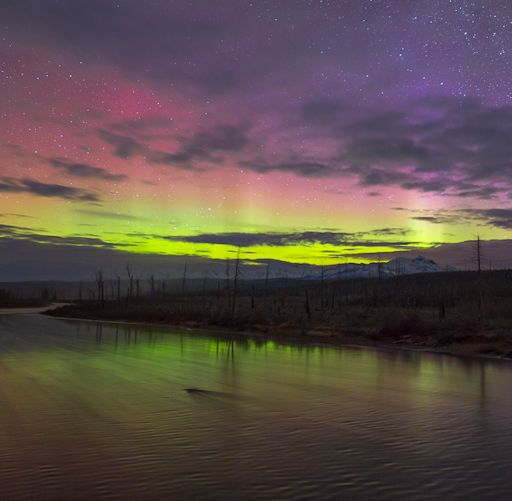
"The Northern Lights made two surprise appearances last night in the Flathead Valley of Montana," says photographer Philip Granrud. "Considering how low the K index seemed to be, I'm quite surprised Montana had as big a show as we did. The colors were amazing!"
More auroras could be in the offing. NOAA forecasters estimate a 35% chance of geomagnetic storms on Feb. 23rd as the solar wind continues to blow. Aurora alerts: text, voice
SUNSET SKY SHOW CONTINUES: Have you caught the sunset conjunction of Venus and Mars? Jean-Baptiste Feldmann did, last night in Fussey, France:
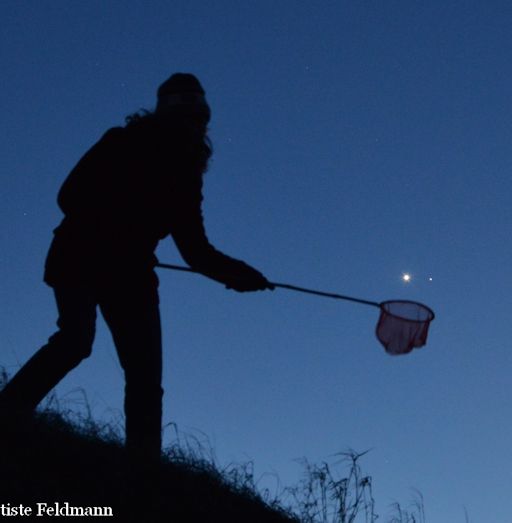
"I took this picture using a Nikon D3200 camera set at ISO 800 for a 5 sec exposure," says Feldmann.
Photographers should take note of those settings, because the conjunction is still underway tonight. At closest approach on Feb. 21st, the two planets were only 0.4o apart. They are separating now, but still only 1o apart--a lovely pair. Look for them in the western sky at sunset. Brilliant Venus pops into view first, followed by Mars as the twilight fades to black. It's a beautiful way to end the day.
Realtime Space Weather Photo Gallery
AIRBUS OVERHEAD: Astrophotographer Ralf Vandebergh of the Netherlands is known for his fabulous photos of the International Space Station. He points his telescope at the fast-moving spacecraft and, moving the tube by hand, keeps the ISS centered in the field of view long enough for a glittering snapshot. Last night, Vandebergh noticed a different light in the sky--not the ISS--and turned his telescope on it instead. This is what he saw:
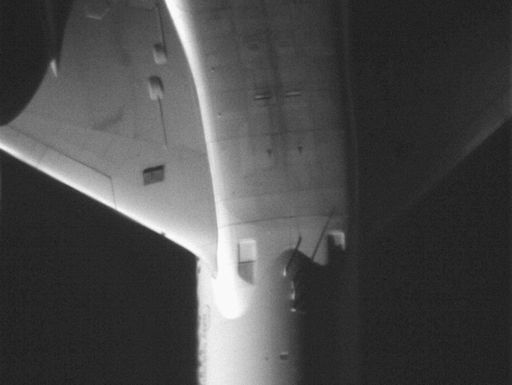
"It was an Airbus A380 flying at 38000 feet at cruise altitude from Dubai to Manchester," says Vandebergh. "I captured this picture using my 25cm Newtonian just as the plane was passing almost exactly overhead at a speed of 460 knots."
Apparently, airplanes can be as fine a target for astrophotogaphy as spacecraft. Unfortnately, we cannot predict flybys of the Airbus. We can, however, forecast the International Space Staton. Click here for local flyby predictions.