EXPLOSION ON THE SUN: Today, Feb. 24th at approximately 11:00 UTC, NASA's Solar Dynamics Observatory recorded a spectacular eruption near the sun's southeastern limb. The blast was rooted on the backside of the sun, but some of the explosion's debris fell back to the sun on the frontside. Play the movie. Earth was not in tthe line of fire. Solar flare alerts: text, voice
CHINESE ROCKET RE-ENTRY: Last night, Feb. 23-24, sky watchers in the western half of North America witnessed a spectacular cluster of fireballs and meteors. We now know it was the re-entry and breakup of a Chinese rocket body, specifically stage 3 of the CZ-4B rocket that launched the Yaogan Weixing 26 satellite in Dec. 2014. Donny Mott photographed the glowing debris from Spirit Lake, Idaho:
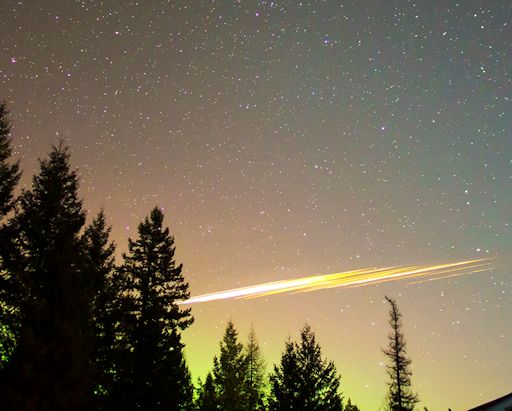
Mott was watching last night's display of auroras around 10 pm local time when the fragments flew by. "It was super bright," he says. "You can see it breaking up in these 4 images I took 10 seconds apart."
Another photographer, John Arnold, caught the meteor flying over Craig, Montana: photos.
According to satellite tracking expert Ted Molczan, "there are confirmed sightings from Arizona, Utah, Nevada, Wyoming, Idaho, Oregon, Washington, Montana, British Columbia, Alberta. The most southerly observation I have noted so far was from Scottsdale, Arizona; the most northerly from Didsbury, Alberta. That spans nearly 3000 km of the descent." Molczan has prepared a map of sightings along with the ground track of the decaying rocket body:

The re-entering rocket body traveled from south to north. Molczan says "the approximate toe of the debris footprint (should any have survived to impact Earth) would be well into Canada."
Monitor the realtime photo gallery for more sightings:
Realtime Space Weather Photo Gallery
SOLAR WIND SPARKS AURORAS: A solar wind stream continues to gently buffet Earth's magnetic field. Last night, Feb. 23-24, a G1-class geomagnetic storm broke out, causing an outburst of auroras around the Arctic Circle. At the peak of the disturbance, Northern Lights spilled across Canadian Border into upper-tier US states including Washington, Montana, Idaho and, shown here, South Dakota:
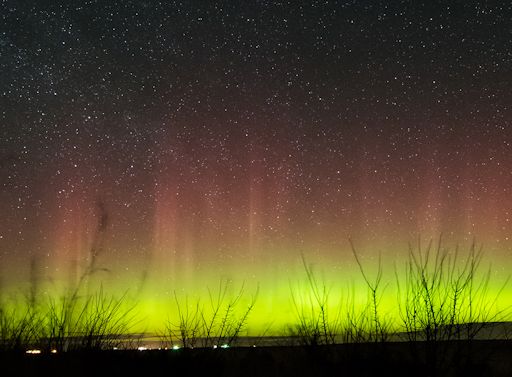
"The lights were visible to the unaided eye and quite bright at times," says photographer Randy Halverson of Kennebec, SD.
The storm also sparked Southern Lights. New Zealand photographer Ian Griffin reports "an amazing night of auroras in Dunedin, Otago. We witnessed a display that lasted well over 4 hours with many pleasing beams and colors!" See his photos
More auroras could be in the offing. NOAA forecasters estimate a 20% chance of geomagnetic storms on Feb. 24-25 as the solar wind continues to blow. Aurora alerts: text, voice
SUNSET SKY SHOW CONTINUES: Have you caught the sunset conjunction of Venus and Mars? Jean-Baptiste Feldmann did, last night in Fussey, France:
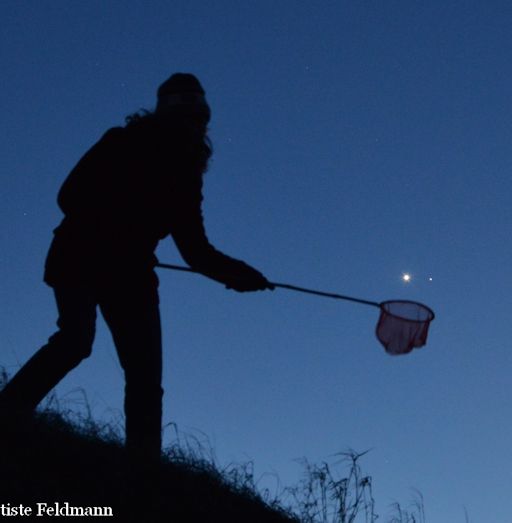
"I took this picture using a Nikon D3200 camera set at ISO 800 for a 5 sec exposure," says Feldmann.
Photographers should take note of those settings, because the conjunction is still underway tonight. At closest approach on Feb. 21st, the two planets were only 0.4o apart. They are separating now, but still only about 1o apart--a lovely pair. Look for them in the western sky at sunset. Brilliant Venus pops into view first, followed by Mars as the twilight fades to black. It's a beautiful way to end the day.