SOLAR WIND SPARKS NORTHERN LIGHTS: A solar wind stream hit Earth's magnetic field during the late hours of Feb. 28th, causing compass needles to swerve and sparking bright auroras around the Arctic Circle. Mika-Pekka Markkanen was exploring a cave in Iceland when the G1-class geomagnetic storm peaked. He looked out and took this picture:

"Simply wow!" says Markkanen. "It was a spectacular display. I got so many wonderful shots from different locations during one night that its bit overwhelming!"
The storm has subsided, but only temporarily. Earth is still inside the solar wind stream, so more auroras are in the offing. NOAA forecasters estimate a 60% chance of polar geomagnetic storms on March 1-2. Aurora alerts: text, voice
NOCTILUCENT CLOUDS, BEHAVING STRANGELY: The southern season for noctilucent clouds (NLCs) has come to an end. NASA's AIM spacecraft observed the last wisps of electric-blue over Antarctica on Feb. 20, 2015. The end of the season was no surprise: The polar clouds always subside in late summer. Looking back over the entire season, however, reveals something unexpected. In an 8-year plot of Antarctic noctilucent cloud frequencies, the 2014-2015 season is clearly different from the rest:

These data come from the AIM spacecraft, which was launched in 2007 to monitor NLCs from Earth orbit. The curves show the abundance ("frequency") of the clouds vs. time for 120 days around every southern summer solstice for the past 8 years.
"This past season was not like the others," notes Cora Randall, a member of the AIM science team and the chair of the Department of Atmospheric and Oceanic Sciences at the University of Colorado. "The clouds were much more variable, and there was an enormous decrease in cloud frequency 15 to 25 days after the summer solstice. That's when the clouds are usually most abundant."
What does this mean? Previous research shows that NLCs are a sensitive indicator of long-range teleconnections in Earth's atmosphere, which link weather and climate across hemispheres. The strange behavior of noctilucent clouds in 2014-2015 could be a sign of previously unknown linkages. "Preliminary indications are that it is indeed due to inter-hemispheric teleconnections," says Randall. "We're still analyzing the data, so stay tuned."
Now attention turns to the northern hemisphere, where the season for NLCs typically begins in May. Will the northern season ahead be as strangely variable as the southern season, just concluded? Says Randall, "I can't wait to find out."
Realtime Space Weather Photo Gallery
WHAT ARE THE ODDS? On Feb.19th, Spaceweather.com and the students of Earth to Sky Calculus launched a helium balloon to the stratosphere. The payload, a cosmic radiation buoy, traveled 112,030 feet above Earth's surface and drifted more than 85 linear miles from the launch site. When it parachuted back to Earth, it landed in a sparsely vegetated stretch of Nevada desert. Getting caught in a tree would seem unlikely, yet that's exactly what happened:
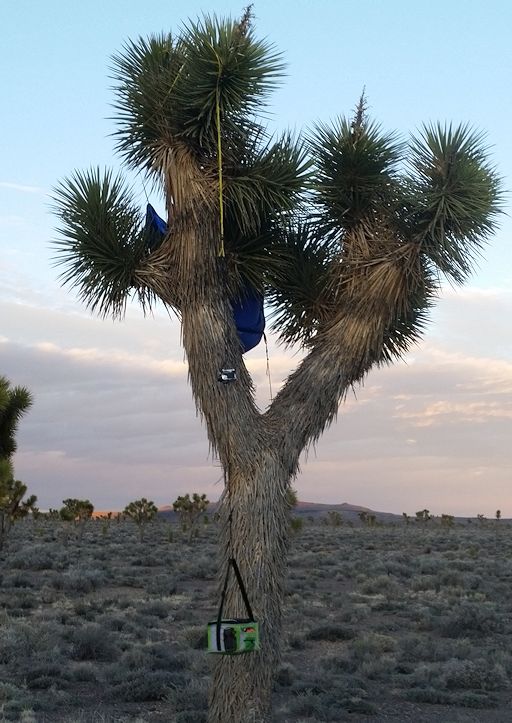
The payload descended into a beautiful forest of Joshua trees, and one of them snagged the parachute. As the student recovery team learned, disentangling the cords of a parachute from the spikey embrace of a Joshua tree is no easy trick. Nevertheless, they persisted and won back their radiation buoy.

The students have been flying radiation buoys to the stratosphere since 2013. Their purpose is to monitor the effect of cosmic rays and solar activity on the upper atmosphere. This buoy carried a pair of ionizing radiation detectors, sensitive to X-rays, gamma-rays and beta particles in the energy range 10 keV to 20 MeV.
A preliminary look at the Feb. 19th data reveals some of the highest radiation levels recorded in the 2-year history of the program. This could be a result of the current spate of low solar activity. Cosmic rays are repelled by CMEs and strong solar magnetic fields. When the sun is quiet, cosmic rays penetrate the solar system in greater numbers--an effect which the students are monitoring with their balloon flights.