DAWN SPACECRAFT ORBITS CERES: NASA's ion-propelled Dawn spacecraft made history today when it became the first probe to visit a dwarf planet. Dawn entered orbit around Ceres on March 6 at 4:39 a.m. PST. Maybe now scientists will learn what those mysterious bright spots are! Get the full story from nasa.gov.
WHAT'S AROUND THE BEND? A sunspot hidden just behind the sun's southeastern limb is crackling with solar flares. The strongest so far, an M3-class eruption on March 6th at 04:57 UT, is circled in this extreme UV image from NASA's Solar Dynamics Observatory:

A pulse of extreme UV radiation from the flare ionized the upper layers of Earth's atmosphere, causing a short-lived blackout of radio communications over Indonesia and surrounding waters: blackout map. Mariners and ham radio operators in the area would have noticed weak signals at frequencies below 10 MHz.

The source of the flare will be revealed in the days ahead as the sun's rotation turns the underlying sunspot toward Earth. Stay tuned. Solar flare alerts: text, voice
Realtime Space Weather Photo Gallery
MINI FULL MOON: You've heard of the supermoon. Last night's full Moon was the opposite--a mini Moon, smaller and dimmer than usual. The apparent size of the Full Moon changes throughout the year because the Moon's orbit is not a circle, it is an ellipse, with one side (apogee) 50,000 km farther from Earth than the other (perigee): diagram. The full Moon of March 5th was an apogee Moon.

Alan Dyer photographed the mini-Moon rising over the Santa Rita Copper Mine, near Silver City, New Mexico, "making for a coppery Moon rising over a copper mine," he says.
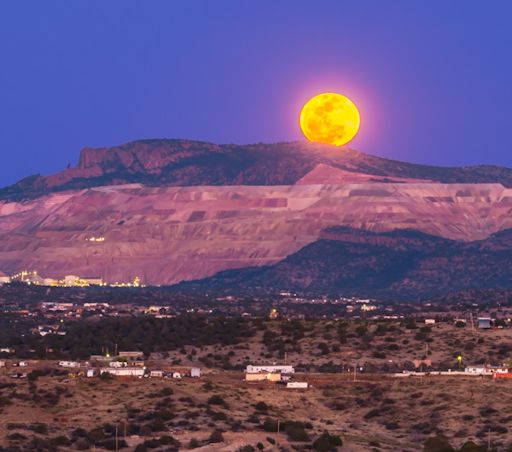
Some people say you cannot tell the difference between a supermoon and a mini-Moon. There are no rulers floating in the sky to measure lunar diameters, and without a reference, one full Moon looks much the same as any other.
Dyer plans to find out: "With luck," he says, "7 lunations from now I will shoot the Sept 27th perigee supermoon with the same optical setup to create a big & little Moon comparison pair."
Meanwhile, browse the photo gallery for a little moonlight.
Realtime Space Weather Photo Gallery
SPACE SEEDS: In late February, the students of Earth to Sky Calculus conducted an experiment in "space agriculture." Using a sub-orbital helium balloon, they flew a dozen varieties of garden vegatables and flowers to the edge of space. Here are three of the seed packets photographed at an altitude of 112,030 feet:
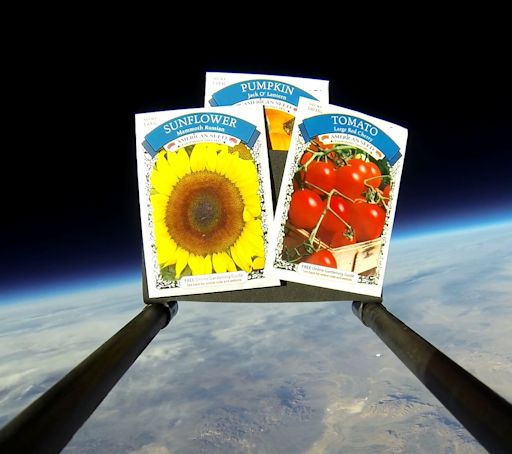
During their ascent to the stratosphere, these seeds (and 80 other packets not shown) experienced temperatures as low as -63 C, air pressures akin to those on the planet Mars, and cosmic ray dose rates 40x Earth-normal. While these "space seeds" were flying to the edge of space, identical control samples remained behind on Earth.
Students intend to plant the flown seeds side-by-side with control samples to investigate whether near-space travel affects the viability, color, size, taste or other characteristics of the plants.
Readers, would you like to grow your own space garden? For a small donation of $49.95 to Earth to Sky Calculus, you can have some of these space seeds for yourself. They make a great science fair project and, possibly, a unique meal! You may chose any two seed types from the following list: turnips, cherry tomatoes, beefsteak tomatoes, sweet corn, green beans, bell peppers, helichrysum flowers, jalapeno peppers, petunias, radishes, sunflowers, cosmos flowers, pumpkins, broccoli and carrots. We will send you flown+control packets for both of your selections. Contact Dr. Tony Phillips to place your order. All proceeds support student research.