CME TO MISS EARTH: The M9-class solar flare of March 7th, described below, did produce a CME: movie. However, NOAA analysts say the expanding cloud will miss Earth. No geomagnetic storms are expected as a result of the explosion. Aurora alerts: text, voice

SOLAR FLARE AND RADIO BLACKOUT: Sunspot AR2297 erupted on March 7th, producing a powerful solar flare that almost crossed the threshold of X-territory. The explosion, classified M9 on the Richter Scale of Flares, produced a bright flash of extreme UV radiation, shown here in an image taken by NASA's Solar Dynamics Observatory:

Radiation from the flare ionized the upper layers of Earth's atmosphere on the dayside of the planet. This caused a moderate HF radio blackout over the Pacific Ocean. Mariners and hams operating at frequencies below 10 MHz would likely have noticed disturbed and/or attenuated signals in the red zone of this NOAA blackout map:
 .
More flares are in the offing. AR2297 has developed a 'beta-gamma-delta' magnetic field that harbors energy for X-class solar flares. NOAA forecasters estimate a 10% chance of such an explosion on March 9th. Stay tuned. Solar flare alerts: text, voice
UNUSUAL HAM RADIO PROPAGATION: It may seem strange, but solar flares can be both good and bad for radio communications. It all depends on the frequency. Below 10 MHz, signals were strongly attenuated. At higher frequencies, however, the reflectivity of the ionosphere was increased, allowing improved over-the-horizon communications. Ham radio operator Bob MacKenzie of Ottawa, Canada, shares this anecdote: "Only minutes after the M9 flare on March 7th, I was able to work three amateur stations in Japan using just 5 watts of single-sideband power and a single-element vertical antenna in my backyard. It's a rare event to work Japan so easily with such little power on phone and not Morse code. The annual ARRL International DX Phone contest was on at the time so there were plenty of DX stations on the air, making this observation of unusual propagation possible." Solar flare alerts: text, voice
Realtime Space Weather Photo Gallery
SPACE SEEDS: In late February, the students of Earth to Sky Calculus conducted an experiment in "space agriculture." Using a sub-orbital helium balloon, they flew a dozen varieties of garden vegatables and flowers to the edge of space. Here are three of the seed packets photographed at an altitude of 112,030 feet:
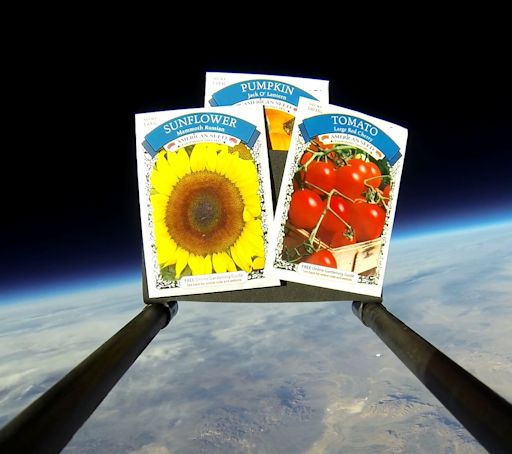
During their ascent to the stratosphere, these seeds (and 80 other packets not shown) experienced temperatures as low as -63 C, air pressures akin to those on the planet Mars, and cosmic ray dose rates 40x Earth-normal. While these "space seeds" were flying to the edge of space, identical control samples remained behind on Earth.
Students intend to plant the flown seeds side-by-side with control samples to investigate whether near-space travel affects the viability, color, size, taste or other characteristics of the plants.
Readers, would you like to grow your own space garden? For a small donation of $49.95 to Earth to Sky Calculus, you can have some of these space seeds for yourself. They make a great science fair project and, possibly, a unique meal! You may chose any two seed types from the following list: turnips, cherry tomatoes, beefsteak tomatoes, sweet corn, green beans, bell peppers, helichrysum flowers, jalapeno peppers, petunias, radishes, sunflowers, cosmos flowers, pumpkins, broccoli and carrots. We will send you flown+control packets for both of your selections. Contact Dr. Tony Phillips to place your order. All proceeds support student research.