MUST-SEE AURORA PHOTO: On March 9th, ISS commander Barry Wilmore looked out the window of the space station and saw an amazing display of auroras. The green lights were dancing around the Antarctic Circle in response to a high-speed stream of solar wind buffeting Earth's magnetic field. It could happen again on March 13-14 when another stream of solar wind is expected to arrive. Polar sky watchers on Earth, and in Earth-orbit, should remain alert for auroras. Solar flare alerts: text, voice
THE ERUPTIONS CONTINUE (updated): For the 4th day in a row, sunspot AR2297 is crackling with solar flares. The latest, an M5-class eruption on March 9th at 23:53 UT, produced a low-frequency radio blackout over the South Pacific: map. NASA's Solar Dynamics Observatory caught the explosion's extreme UV flash:


Update: SOHO coronagraphs have observed multiple CMEs emerging from the blast site; movie. The confusing mass of plasma clouds is traveling mostly away from the sun-Earth line. Nevertheless, one or more of the CMEs could deliver a glancing blow to Earth's magnetic field in the days ahead. Stay tuned as NOAA analysts sort things out.

What is the source of all this activity? According to amateur astronomer John Chumack, "it's a great big Sea Turtle." Using a backyard solar telescope in Dayton, Ohio, he took this picture of the turtle's head on March 9th:

The sunspot's primary dark core is the turtle's eye, while a magnetic filament traces the profile of Eretmochelys imbricata. This tension-filled filament does more than give the active region a likeness to marine life; it also harbors energy for powerful magnetic explosions. NOAA forecasters estimate a 40% chance of additional M-class flares on March 10th. Stay tuned. Solar flare alerts: text, voice
Realtime Space Weather Photo Gallery
SPACE SEEDS: In late February, the students of Earth to Sky Calculus conducted an experiment in "space agriculture." Using a sub-orbital helium balloon, they flew a dozen varieties of garden vegatables and flowers to the edge of space. Here are three of the seed packets photographed at an altitude of 112,030 feet:
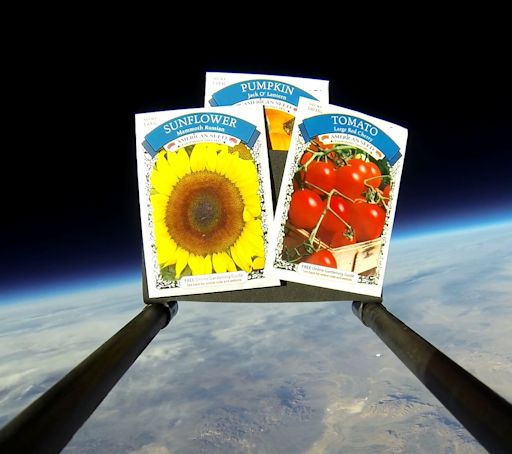
During their ascent to the stratosphere, these seeds (and 80 other packets not shown) experienced temperatures as low as -63 C, air pressures akin to those on the planet Mars, and cosmic ray dose rates 40x Earth-normal. While these "space seeds" were flying to the edge of space, identical control samples remained behind on Earth.
Students intend to plant the flown seeds side-by-side with control samples to investigate whether near-space travel affects the viability, color, size, taste or other characteristics of the plants.
Readers, would you like to grow your own space garden? For a small donation of $49.95 to Earth to Sky Calculus, you can have some of these space seeds for yourself. They make a great science fair project and, possibly, a unique meal! You may chose any two seed types from the following list: turnips, cherry tomatoes, beefsteak tomatoes, sweet corn, green beans, bell peppers, helichrysum flowers, jalapeno peppers, petunias, radishes, sunflowers, cosmos flowers, pumpkins, broccoli and carrots. We will send you flown+control packets for both of your selections. Contact Dr. Tony Phillips to place your order. All proceeds support student research.