WAITING FOR CMES: A series of minor CMEs expected to hit Earth on March 13th have not reached our planet. Nevertheless, analysts think they are still coming. NOAA forecasters estimate a 60% chance of G1-class geomagnetic storms on March 14th in response to a belated arrival. Aurora alerts: text, voice
HAPPY PI DAY: Today, March 14th (3.14), is  day, and all around the world pi-philes are celebrating one of the most compelling and mysterious constants of Nature. Pi appears in equations describing the orbits of planets, the colors of auroras, the structure of DNA. The value of is woven into the fabric of life, the universe and ... everything.

Humans have struggled to calculate for thousands of years. Divide the circumference of a circle by its diameter; the ratio is . Sounds simple, but the devil is in the digits. While the value of is finite (a smidgen more than 3), the decimal number is infinitely long:
3.1415926535897932384626433832795
02884197169399375105820974944592307
81640628620899862803482534211706...more
Supercomputers have succeeded in calculating more than 2700 billion digits and they're still crunching. The weirdest way to compute : throw needles at a table or frozen hot dogs on the floor. Party time.
SOLAR RADIO BURST: For much of the week, space weather news has focused on how sunspot AR2297 is causing radio blackouts on Earth. On March 12th the sunspot did the opposite. It unleashed a shortwave radio burst. "It was super intense--one of the strongest bursts of the current solar cycle," reports amateur radio astronomer Thomas Ashcraft. Click on the image below to play a recording of the sounds he heard issuing from the loudspeaker of his radio telescope in rural New Mexico:
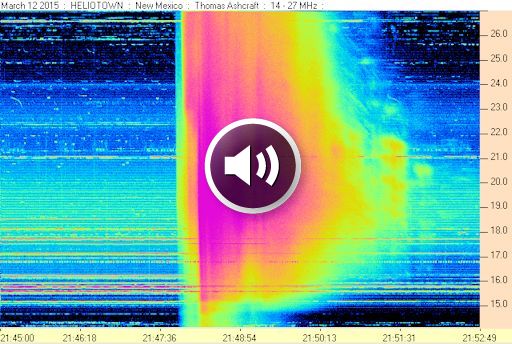
"The recording starts a little rough for a few seconds in that there was a ham transmission in progress on one channel (22 MHz) and the other channel (23 MHz) had a tiny bit of buzz," says Ashcraft. "But then the solar burst hit and the ham voices were entirely drowned out. For the next 3 minutes, the airwaves were dominated by solar static."
These radio sounds are caused by beams of electrons--in this case, accelerated by an M4-flare. As the electrons slice through the sun's atmosphere, they generate a ripple of plasma waves and radio emissions detectable on Earth 93 million miles away. Astronomers classify solar radio bursts into five types; Ashcraft's recording captured a mixture of Type III and Type V.
More bursts are in the offing. AR2297 has an unstable 'beta-gamma-delta' magnetic field that harbors energy for 'radio-active' explosions. NOAA forecasters estimate a 70% chance of M-class flares and a 20% chance of X-flares on March 14th. Solar flare alerts: text, voice
Realtime Space Weather Photo Gallery
IMPORTANT SPACE WEATHER LAUNCH: Why do solar flares explode? On Thursday night, NASA launched a fleet of spacecraft to answer that question. Blasting off from Cape Canaveral, the four probes of the Magnetospheric Multiscale (MMS) mission will spend the next 2 years flying in formation around Earth. Their mission: to study magnetic reconnection, the mysterious process that powers solar flares and geomagnetic storms. Photographer Ben Cooper watched the rocket roar into space from a remote viewing site in the Ponce de Leon Inlet, Florida:
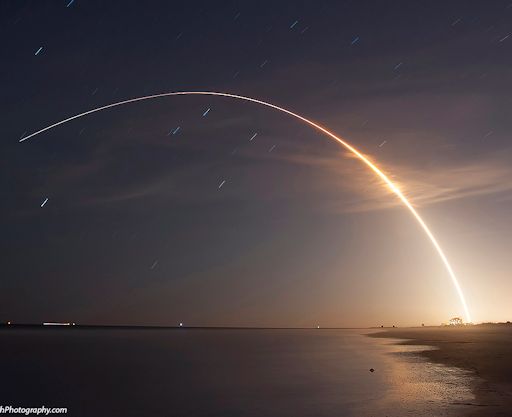
"The Atlas 5 rocket streaked into the sky with NASA's four Magnetospheric Multiscale probes," says Cooper. "It was a beautiful view 40.7 miles north of launch Complex 41."
Shortly after launch, the rocket experienced an outgassing event. The resulting spherical cloud, which some observers are calling the "MMS Nebula" was visible to the naked eye as far away as Texas. Bryan Tobias of San Antonio took this picture from his front yard. Ed Cannon of Austin, Texas, says "it was about twice the size of the full Moon, generally circular, and very easy to see without any magnification. About two minutes later it had grown in size to several degrees in length." What created this cloud? A post on the NASA Spaceflight forum suggests that it may have been fumes from reaction control thrusters, which helped the MMS probes spin up just before deployment.
More photos of the launch and the MMS Nebula may be found in the realtime photo gallery:
Realtime Space Weather Photo Gallery