ST. PATRICK'S DAY GEOMAGNETIC STORM: Arriving earlier than expected, a CME hit Earth's magnetic field on March 17th at approximately 04:30 UT. At first, the impact sparked a relatively mild G1-class (Kp=5) geomagnetic storm. Since then, however, the storm has intensified to G4-class (Kp=8), ranking it as the strongest geomagnetic storm of the current solar cycle. This storm is underway now. Before sunrise on St. Patrick's Day, bright auroras were sighted over several northern-tier US states including Minnesota, Wisconsin, Montana, the Dakotas and Washington. Marketa Murray sends this picture from Dalton Highway in Alaska:
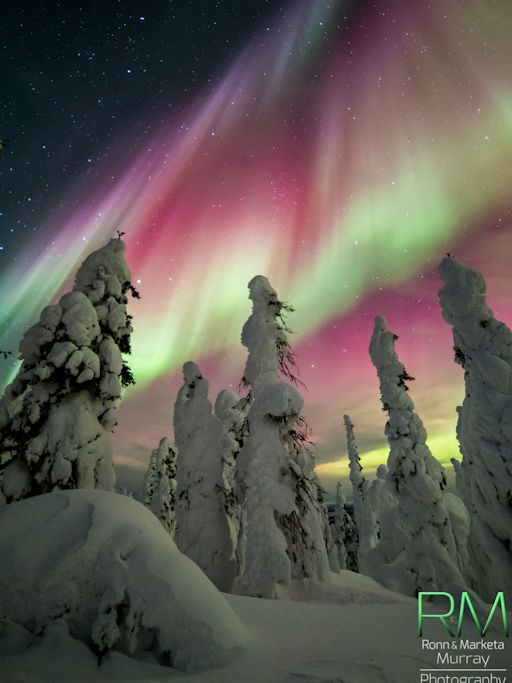
"The auroras were insane," says Marketa who regularly runs a photography workshop on the Arctic Circle. She has seen a lot of auroras. "I have never seen anything like this."
This storm could continue for many hours to come as Earth passes through the turbulent wake of the CME. Stay tuned for updates. Geomagnetic storm alerts: text, voice
SPACE YEAST: Today, March 17th, Spaceweather.com and the students of Earth to Sky Calculus are flying a Space Weather Buoy into the geomagnetic storm to measure the effect of the CME's impact on cosmic rays in the stratosphere. Along with radiation detectors and other sensors, the payload will carry some hitchhikers--brewer's and baker's yeast:

This picture shows packets of yeast flown to the edge of space last week. More of the microbes will fly today to experience the geomagnetic storm. During their ascent to the stratosphere, they will receive a dose of cosmic rays at least 40 times Earth-normal.
What can you do with Space Yeast? Bake space bread, brew space beer, or whip up any recipe that calls for yeast. Also, teachers and homeschoolers can conduct some cool classroom experiments.
If you would like a packet of space yeast, you can have one by making a donation of $49.95 to Earth to Sky Calculus. Every flown packet comes with a control packet that remained behind on Earth during the flight, so you can conduct a properly-controlled scientific experiment. All proceeds support student space weather research. Contact Dr. Tony Phillips to place your order.
BRIGHT FIREBALL, POSSIBLE METEORITE FALL: On March 15th, a meteor exploded over southern Germany. The shadow-casting fireball was brighter than the full Moon and it produced loud sonic booms – a sign that it penetrated deep in the atmosphere and may have dropped meteorites on the ground. Attracted by the sounds, astrophotographer Hans Hopf of Bavaria, Germany, turned his camera to the sky just in time to capture a plume of debris twisting in the winds overhead:
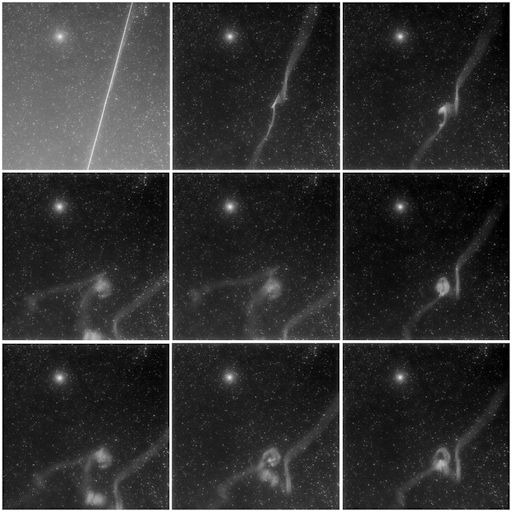
"I could see the 'smoke' twisting and turning through the constellation Orion for more than 20 minutes after the meteor exploded," says Hopf. "The field of view of these images is about 10 degrees. The bright star is Betelgeuse (Alpha Orionis)."
The International Meteor Organization is gathering eyewitness reports through their new online reporting tool. European readers, if you witnessed this event, please report it. Your sighting could help pinpoint the landing zone of possible meteorites.
Realtime Space Weather Photo Gallery