WEEKEND GEOMAGNETIC ACTIVITY: Earth's magnetic field above the Arctic Circle is experiencing intermittent geomagnetic storms. These are, essentially, reverberations from the March 17th CME impact amplified to storm-strength by the action of a passing solar wind stream. Polar sky watchers should remain alert for auroras. Aurora alerts: text, voice
SNAPSHOTS FROM THE ECLIPSE: What are the odds? Yesterday, March 20th, just as the Moon was passing in front of the Sun, producing a deep solar eclipse over Europe, the International Space Station flew directly through the eclipse zone. Thierry Legault photographed the split-second transit from Fregenal de la Sierra, Spain:
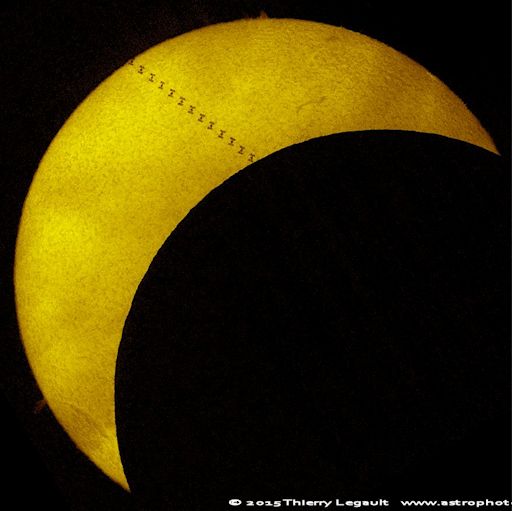
"I had to drive a lot to find clear skies," says Legault, "but I managed to catch the ISS during the eclipse. The duration of the visible part of the transit was only 0.6s." See the Youtube video!
Meanwhile in the ionosphere.... The eclipse had a dramatic effect on the ionization of Earth's upper atmosphere. Normally, during the day, solar UV radiation breaks apart atoms and molecules, creating a layer of ionized gas hundreds of kilometers above Earth's surface. The Moon, however, blocked those UV rays. Subsequent changes to the ionization structure of atmosphere altered the propagation of radio waves in the eclipse zone. Take a look at these data from Rudolf Slošiar, who operates a VLF (very low frequency) radio monitoring station in Bojnice, Slovakia:
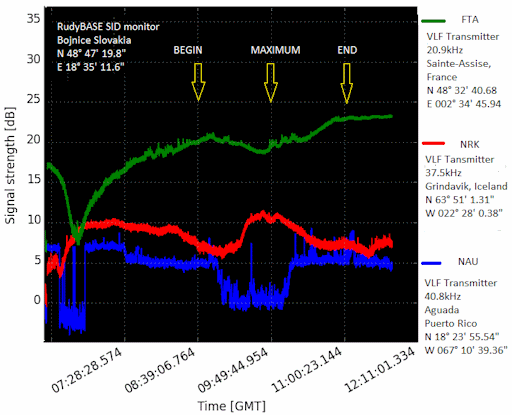
"During the solar eclipse, significant changes in the the D layer of the ionosphere affected the transmission of radio stations I record using my SID monitor, " says Slošiarl. Signals from Iceland were boosted, while radio stations in France and Puerto Rico dropped out.
For more anecdotes from the eclipse, monitor Spaceweather.com's realtime photo gallery:
Realtime Space Weather Photo Gallery
SPACE YEAST: On March 17th, during the strongest geomagnetic storm of the current solar cycle, Spaceweather.com and the students of Earth to Sky Calculus launched a Space Weather Buoy to measure the effect of the CME's impact on cosmic rays in the stratosphere. Along with radiation detectors and other sensors, the payload carried some hitchhikers--brewer's and baker's yeast:

During their ascent to the stratosphere, the yeast experienced temperatures as low as -60 C, air pressures only 1% of sea level, and cosmic ray dose rates 40 times Earth-normal.
What can you do with Space Yeast? Bake space bread, brew space beer, or whip up any recipe that calls for yeast. Also, teachers and homeschoolers can conduct some cool classroom experiments.
If you would like a packet of space yeast, you can have one by making a donation of $49.95 to Earth to Sky Calculus. Every flown packet of baker's yeast comes with a control packet that remained behind on Earth during the flight, so you can conduct a properly-controlled scientific experiment. All proceeds support student space weather research. Contact Dr. Tony Phillips to place your order.
AURORAL CHORUS: Earth is a natural radio. Plasma waves coursing through the magnetosphere produce a symphony of "tweeks," "whistlers" and "sferics." Radio receivers operating at very low frequencies (0.1 to 10 kHz) pick up these otherworldy sounds on a daily basis. On March 17th, the symphony reached fever pitch. Radio observer Kevin Palivec reports from Hawley, Texas: "During this week's powerful geomagnetic storm, I picked up a very low frequency (VLF) radio phenomena called 'auroral chorus' for the first time." Click to listen to a sample recording:
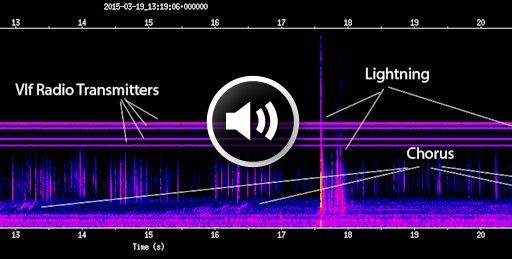
"It sounds like birds chirping with the bacon frying in the background," he describes. "I never thought I would detect these signals as far south as Texas. This was one strong magnetic storm."
Readers who wish to monitor Earth's natural radio emisions for themselves can buy a NASA VLF radio receiver kit from the INSPIRE project. It's a fun project for scientists of all ages.