GEOMAGNETIC ACTIVITY: For the 5th day in a row, a high-speed (600 km/s) solar wind stream is buffeting Earth's magnetic field, sparking mild geomagnetic storms around the Arctic Circle. High-latitude sky watchers should remain alert for auroras on March 23rd. Aurora alerts: text, voice
INSIDE THE SHADOW OF THE MOON: Warning: The movie you are about to see could turn you into an eclipse-chaser. Last Friday, March 20th, the Moon passed directly in front of the sun, producing a total eclipse over the Arctic Ocean. For almost three minutes, the cool shadow of the Moon fell on Svalbard, also known as "the island of polar bears" because of its large population of Ursus maritimus. Nick James, who became an eclipse-chaser long ago, was in Longyearbyen, Svalbard, for the event, and he made this movie:

"This eclipse was one of my best," says James. "The weather was perfect and the corona was amazing in a very transparent deep blue sky. There were interesting prominences and dramatic shadow bands--both of which are shown in the movie. At totality, the temperature dropped below -20 C, which was a challenge for both the photographer and his cameras!"
Meanwhile in the ionosphere: The eclipse had a dramatic effect on the ionization of Earth's upper atmosphere. Normally, during the day, solar UV radiation breaks apart atoms and molecules, creating a layer of ionized gas hundreds of kilometers above Earth's surface. The Moon, however, blocked those UV rays. Subsequent changes to the ionization structure of the atmosphere altered the propagation of radio waves in a broad region around the eclipse zone. Take a look at these data from Rudolf Slošiar, who operates a VLF (very low frequency) radio monitoring station in Bojnice, Slovakia:
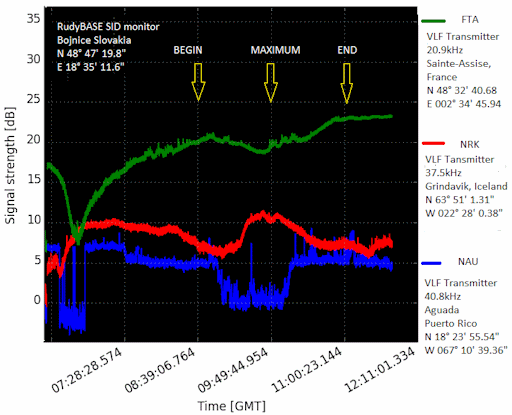
"During the solar eclipse, significant changes in the the D layer of the ionosphere affected the transmission of radio stations I record using my SID monitor," says Slošiarl. Signals from Iceland were boosted, while radio stations in France and Puerto Rico dropped out.
For more anecdotes from the eclipse, monitor Spaceweather.com's realtime photo gallery:
Realtime Space Weather Photo Gallery
SPACE YEAST: On March 17th, during the strongest geomagnetic storm of the current solar cycle, Spaceweather.com and the students of Earth to Sky Calculus launched a Space Weather Buoy to measure the effect of the CME's impact on cosmic rays in the stratosphere. Along with radiation detectors and other sensors, the payload carried some hitchhikers--brewer's and baker's yeast:

During their ascent to the stratosphere, the yeast experienced temperatures as low as -60 C, air pressures only 1% of sea level, and cosmic ray dose rates 40 times Earth-normal.
What can you do with Space Yeast? Bake space bread, brew space beer, or whip up any recipe that calls for yeast. Also, teachers and homeschoolers can conduct some cool classroom experiments.
If you would like a packet of space yeast, you can have one by making a donation of $49.95 to Earth to Sky Calculus. Every flown packet of baker's yeast comes with a control packet that remained behind on Earth during the flight, so you can conduct a properly-controlled scientific experiment. All proceeds support student space weather research. Contact Dr. Tony Phillips to place your order.