CME TO MISS EARTH: Yesterday, a giant prominence on the sun's eastern limb exploded. The CME it hurled into space is not expected to hit Earth. NOAA analysts say the cloud will sail wide of our planet without even a glancing blow. CME alerts: text, voice

CO-ROTATING INTERACTION REGION: NOAA forecasters estimate a 60% chance of polar geomagnetic storms on March 28th when a co-rotating interaction region (CIR) is expected to hit Earth's magnetic field. CIRs are transition zones between fast- and slow-moving solar wind streams. Solar wind plasma piles up in these regions, producing density gradients and shock waves that do a good job of sparking auroras.
Right behind the CIR, a stream of high-speed solar wind is lurking. It is flowing from this coronal hole in the sun's southern hemisphere:

Image credit: NASA's Solar Dynamics Observatory
Coronal holes are places in the sun's atmosphere where the magnetic field opens up and allows solar wind to escape. In the image, above, curved lines trace the sun's magnetic field; arrows indicate the flow of gaseous material (solar wind) away from the sun. Gas velocities in the stream could be as high as 700 km/s (1.6 million mph). When such a high-speed stream hits Earth, it is likely to spark bright polar auroras. Stay tuned for weekend lights. Aurora alerts: text, voice
Realtime Space Weather Photo Gallery
WHAT'S GOING ON IN THE STRATOSPHERE? Lately, Spaceweather.com and the students of Earth to Sky Calculus have been launching a lot of Space Weather Bouys. The missions aim to solve a minor mystery in the stratosphere. On March 17th, a CME hit Earth's magnetic field, sparking the strongest geomagnetic storm of the current solar cycle. Shortly after the CME hit, ground-based neutron monitors measured a drop in cosmic rays. Here is an example from the monitoring station in Oulu, Finland:

This drop is called a "Forbush Decrease." It happens because the CME sweeps aside cosmic rays that normally surround Earth, causing radiation levels to drop. The Earth to Sky space weather ballooning program has measured two previous Forbush Decreases, on Sept 13th and Dec 21st, 2014. On both occasions, radiation levels in the stratosphere dropped in sync with neutron counts on the ground.
This time, however, was different. Instead of dropping, radiation in the stratosphere ticked upward. At least that is what the Space Weather Buoys are telling us. This particular buoy was launched on March 17th during the peak of the geomagnetic storm:
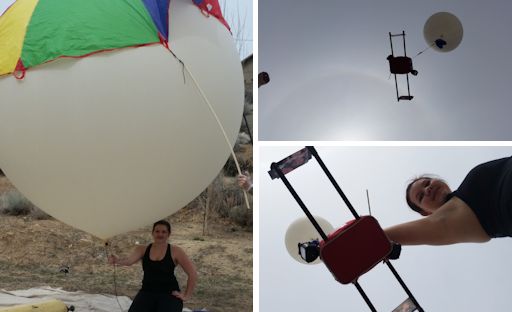
So far, the student team has launched balloons with radiation sensors on March 13th, March 17th, March 21st, and March 24th; and more launches in the offing. By sampling the response of the stratosphere to the great storm--both the initial impact and the rebound--they hope to unravel the puzzle. After a few more flights, the team will share the full data set with the public.
This is crowd-funded research. Every one of Earth to Sky's flights is sponsored by a private individual or company. In exchange for a $500 donation, sponsors can have their logo or favorite family photo transported to the edge of space. Readers, if you would like to contribute to the research, please contact Dr. Tony Phillips for details.
Realtime Eclipse Photo Gallery