CHANCE OF EARTH-DIRECTED FLARES: So far on April 17th, solar activity is low. Sunspot AR2321 is poised to break the quiet. The sprawling sunspot group is directly facing Earth and has an unstable 'beta-gamma' magnetic field that harbors energy for significant eruptions. NOAA forecasters estimate 40% chance of M-flares and a 10% chance of X-flares during the next 24 hours. Solar flare alerts: text, voice.
SOLAR WIND SPARKS BRIGHT AURORAS: For the third day in a row, Earth is passing through a stream of high-speed solar wind. The sustained encounter has sparked some of the brightest auroras of the year around the Arctic Circle. Rune Askeland sends this example from Bergen, Norway, on April 17th:

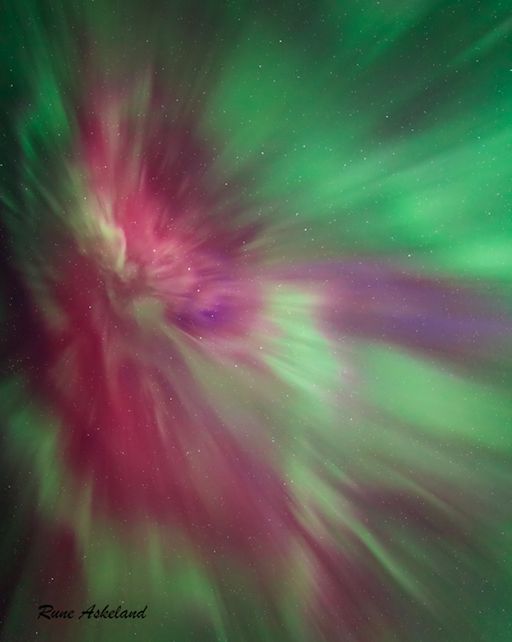
"It is not often that we observe such bright auroras--even here in Norway," says Askeland. "Last night was magic."
During the display over Norway, the geomagnetic storm registered G2 or "moderate" on NOAA storm scales. In North America, that was enough to send auroras spilling over the US-Canadian border as far south as Montana, Wyoming, Washington, Michigan, Minnesota, and Idaho.
NOAA forecasters estimate a 45% chance of G1-class storming on April 17th as the solar wind continues to blow. Aurora alerts: text, voice.
CORONAL HOLE: NASA's Solar Dynamics Observatory (SDO) is monitoring a hole in the sun's atmosphere--a "coronal hole." It is colored deep-blue in this extreme UV image of the sun taken by SDO on April 17th:

Coronal holes are places where the sun's magnetic field opens up and allows solar wind to escape. In the image, above, the sun's magnetic field is traced by white loops. Arrows show the flow of material out of the hole.
Holes in the sun's atmosphere are not unusual; they appear several times each month. A stream of solar wind flowing from this particular coronal hole will probably reach Earth on April 21st. This means we could have auroras for Earth Day. Stay tuned. Aurora alerts: text, voice
Realtime Space Weather Photo Gallery
Realtime Eclipse Photo Gallery